When a central air conditioner misbehaves, the cause is usually on the short list the makers print for owners: the thermostat, the power, the filter, the vents, the outdoor unit’s surroundings, ice on the coil, or a safety switch that stopped cooling on purpose. Check those first, in that order, with every panel closed. If they all look right, the rest sits behind a panel or inside the refrigerant circuit: a technician’s job. Below, each symptom points to the page that covers it.
General information, not professional advice. Your system’s maker, your manual and a qualified technician decide what’s safe for your equipment, and local codes decide what needs a permit or a licensed installer.
If you smell gas at the furnace that holds your AC’s blower: leave the house now. Don’t switch lights or appliances on or off, don’t use a phone inside, and don’t try to find the leak. From outside or a neighbour’s home, call 911 or your gas utility’s emergency line (PHMSA).
How the two halves work together
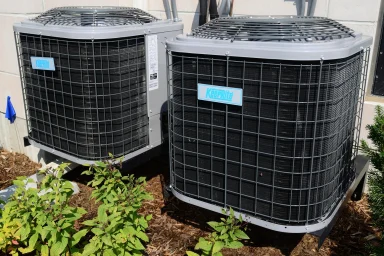
Indoors, a furnace or air handler holds the blower and the evaporator coil, the cold coil the house air passes through. Outdoors, the condensing unit holds the compressor, which pumps refrigerant around the loop, and a coil and fan that shed the heat.
The thermostat’s 24-volt signal runs through the indoor unit to the outdoor unit, where it closes the contactor, a heavy-duty switch that sends 240-volt power to the compressor and fan; a capacitor gives those motors the push to start and run. So a dead indoor unit means a silent outdoor unit, and the blower can keep moving air while nothing cools it. The coil also pulls water out of the air, which drips into a pan and away down a drain.
Three lines you don’t cross
- Power off in more than one place. Trane’s owner guide says to disconnect power to both the indoor and outdoor units before any maintenance, and that “there may be more than one electrical disconnect switch” (Trane 32-5084-1B-EN, 2024).
- Panels stay closed. The outdoor unit carries 240 volts, and its capacitor can hold a charge after the power is off; even the federal workplace rule for electrical work treats capacitors being handled as energized (29 CFR 1910.333(b)(2)(ii)(C)). Never push a fan blade or a contactor to get a unit going.
- No refrigerant work. Attaching gauges, adding or removing refrigerant, or cutting a line is work only an EPA-certified technician may do (40 CFR 82.152 and 82.161). There is no homeowner exception.
Find your symptom
The air isn’t cold
If the system runs but the house stays warm, start with AC not cooling: a step-by-step check. If what comes out of the vents is actually warm, read why an AC blows warm air: the useful question there is which half stopped.
The outdoor unit
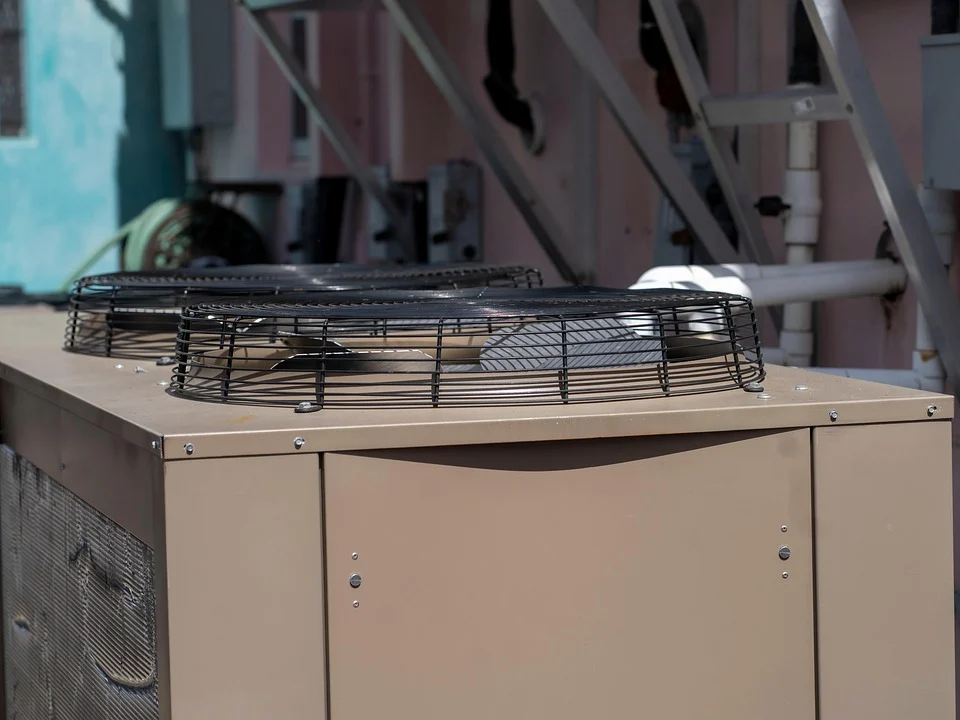
Stand by the outdoor unit for a minute while the thermostat calls for cooling. If it is completely silent, outside AC unit not turning on follows the chain outward from the thermostat. If the compressor hums but the fan on top stands still, turn cooling off at the thermostat first: Carrier warns that running without the outdoor fan makes the compressor overheat. Then read AC fan not spinning; it also covers the indoor blower.
Ice and water
Ice on the copper line or indoor coil means too little warm air across the coil, or too little refrigerant. AC frozen: ice on the coil or lines gives the makers’ thaw: cooling off, fan On, towels down, and leave the ice alone. Water on the floor usually comes from a clogged drain, a melting coil, a stopped pump or a cracked pan; AC leaking water inside helps you find which. Both lead back to the indoor coil itself: the evaporator coil, frozen, dirty or leaking covers who cleans it and what the refrigerant rules mean for replacing one.
Starts, stops and sounds
A system that starts and stops in short bursts, often before the house cools, may be short cycling. The makers don’t agree on a normal run time, so AC short cycling shows how to judge the pattern, and what a system too big for the house does. New sounds are sorted on AC noises. Two need action at once: a buzz with the outdoor fan still, and a hiss near the coil or copper lines, which Trane says may mean a large refrigerant leak. Shut the system off and call for either.
Your checks, in the makers’ order
The symptom pages follow the order of Lennox’s pre-service checks (Lennox, AC System Information for Homeowner/User, 2016), with additions from other makers and DOE:
- Thermostat: mode on Cool, setpoint below the room temperature, fan on Auto; more in the thermostat check in order.
- Wait five minutes. Some thermostats and outdoor units hold the compressor off for a few minutes to protect it. Lennox’s M30 thermostat, for example, has a fixed 5-minute delay between cycles (Lennox 507739-02, 3/2025).
- Power: the switch at the furnace or air handler, its blower door shut (Trane: an ajar door stops the blower), the breakers and the outdoor disconnect. DOE says to let the unit cool five minutes before resetting a breaker (Common Air Conditioner Problems, Internet Archive copy of 8 June 2026). Reset once; if it trips again, leave it off.
- Filter: with the power off, replace a dirty one with the same size and type (Trane). Sources differ on how often: our filter interval comparison.
- Vents and returns open, not behind furniture, rugs or curtains.
- Outdoor unit: with the power off at the disconnect, clear leaves, clippings and anything stacked against it, from the outside only.
- Ice and water: frost on the larger copper line, standing water in the pan under the indoor unit. See how to clear a clogged AC drain line.
The routine version of these jobs, and what a yearly tune-up covers, is on AC maintenance: the owner’s part.
When the system stops itself on purpose
Two safety devices can shut cooling off and look like a breakdown. Neither should ever be taped, jumped or bypassed.
- A float switch in the drain pan or line. DOE says a clogged drain can make the equipment turn off until the drain is cleared (Air Conditioner Maintenance, Internet Archive copy of 14 June 2026). The switch is the part that stopped the flood.
- A refrigerant leak sensor on many newer R-454B and R-32 systems (mildly flammable A2L refrigerants). On a leak, the furnace runs its blower hard to clear it: Lennox’s ML180 stops heating and cooling and shows E150; Goodman’s 80% furnaces with an R-32 system show EAL and shut off gas heat (Lennox 508547-01, 12/2025; Goodman/Daikin RS6621301). Lennox says disabling the detection on an A2L system “is prohibited by safety codes”. Write down the code and call a technician.
Where your part stops
Trane’s owner guide says that beyond its simple maintenance list, owners should not attempt repairs, and that “do-it-yourself” repairs on an in-warranty unit may void the warranty. Leave cooling off and call a technician when:
- a breaker or fuse trips again after one reset;
- the outdoor unit hums or buzzes but the fan doesn’t turn, or it stays silent with power on;
- the coil freezes again after a full thaw, a clean filter and open vents;
- you hear hissing near the coil or lines, or suspect a refrigerant leak;
- water has reached wiring, controls or the furnace, or the pan keeps overflowing; Carrier says not to use a furnace if any part has been under water (Carrier 80GSFRN-B-03OM, edition 08/22);
- a newer system shows a refrigerant leak code;
- you smell burning from the unit or wiring: switch it off at the breaker.
What the technician looks at
Behind the panels, a technician checks the parts the symptom pages point to: the capacitor that starts the motors, the contactor the thermostat’s signal closes, the fan motor, the pressure switches, the compressor, airflow across the indoor coil, and the refrigerant charge.
Refrigerant isn’t used up. Trane says a system only ends up low through a leak or a wrong charge at installation, and there is no federal duty to repair a leak in a home system (40 CFR 84.106(a)(3)(ii)), so ask whether you’re paying for a leak repair or only a top-up. The signs of a refrigerant leak, and what the law asks of the technician has the details. Which refrigerant you have matters too: R-22 has not been produced or imported since 1 January 2020 (EPA-430-FR-20001), while R-410A systems can still be repaired with new components (40 CFR 84.56(b)). If the quote is large or the system is old, the repair or replace check lays out the points to weigh against your own quotes.
Your next step
- Now: run the owner checks once, panels closed. If the compressor runs without its fan or the coil is iced, cooling goes off first.
- Write down: the model and serial numbers and refrigerant from the rating plates, any code on the furnace, what runs and what doesn’t, what you checked, and when it started.
- Ask: which part failed and why, whether a leak will be repaired or only topped up, and whether the part is under warranty.
- Can’t wait: a burning smell from the unit or wiring, a breaker that trips repeatedly, water on electrical parts, or a gas smell at the furnace.
Sources checked on 10 November 2026. DOE Energy Saver pages are cited in Internet Archive copies because the live pages return 404. Each linked page lists its own sources in full.