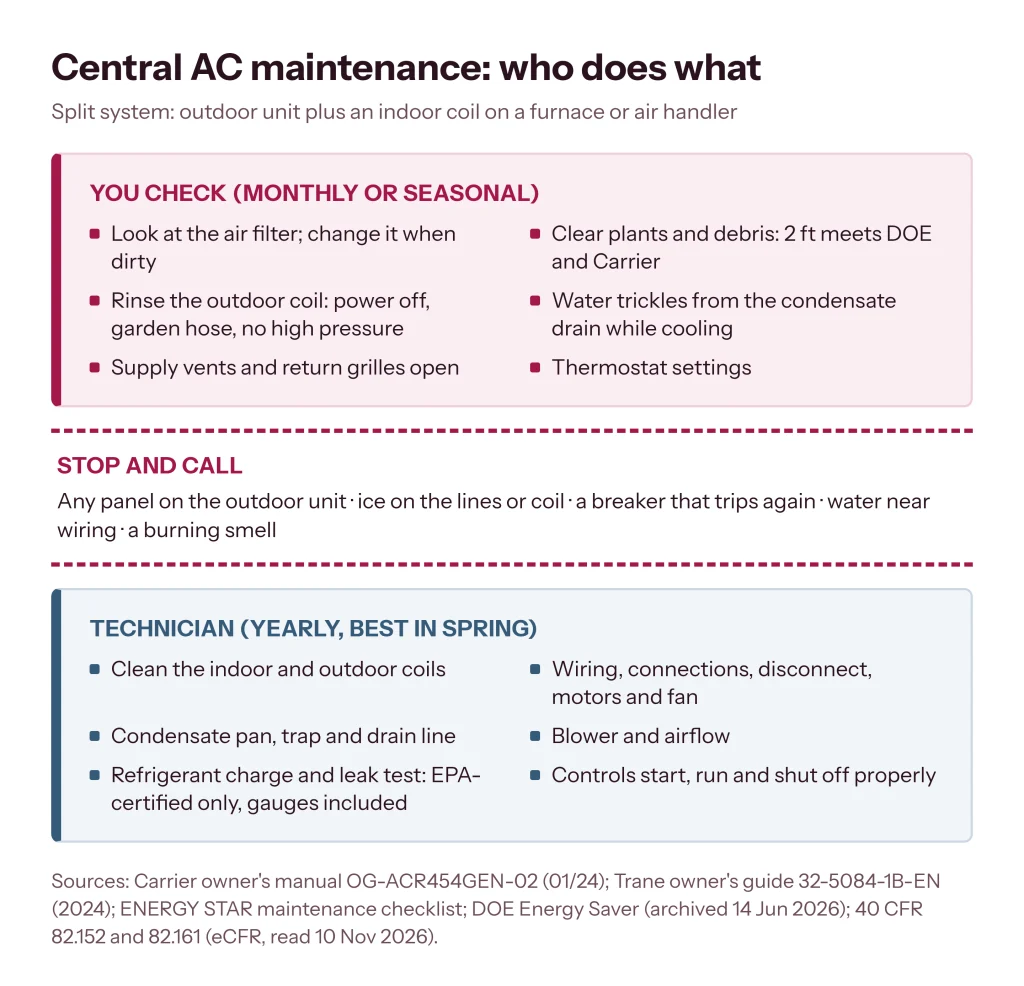
Central air conditioner maintenance comes in two parts. Your part is short and done by hand: keep the air filter clean, keep the outdoor unit clear of plants and debris, rinse its coil with plain water now and then, check that water trickles from the condensate drain while the system cools, and keep vents and return grilles open. The technician’s part comes once a year, best in spring: cleaning the coils, checking the wiring and controls, clearing the drain pan and trap, measuring airflow, and checking the refrigerant charge. Federal law reserves anything that opens the refrigerant circuit, even attaching gauges, to an EPA-certified technician. This page sets out both parts, with the maker or agency each step comes from, and the points where the sources disagree.
It’s part of our maintenance and filter guides. The checks below are for a split system: an outdoor unit (the condenser, with the compressor and a fan) joined by copper refrigerant lines to an indoor coil (the evaporator coil) that sits on a furnace or air handler.
General information, not professional advice. Your system’s maker, your manual and a qualified technician decide what’s safe for your equipment, and local codes decide what needs a permit or a licensed installer.
Read this first: power, gas and water
- Power off at more than one place. Carrier’s and Trane’s owner guides say to disconnect power to both the indoor and outdoor units before maintenance, and both add: “There may be more than one electrical disconnect switch” (Carrier OG-ACR454GEN-02, 01/24; Trane 32-5084-1B-EN, 2024). The outdoor unit is wired to high-voltage household power, and its capacitor can hold a charge after the power is off; OSHA’s workplace rule has workers release stored electric energy and discharge capacitors before working on de-energized equipment for that reason (29 CFR 1910.333(b)(2)(ii)(C)). Nothing on this page asks you to open a panel on the outdoor unit or touch anything inside it.
- If your indoor unit is a gas furnace and you smell gas: leave the house now. Don’t switch lights or appliances on or off, don’t use a phone inside, and don’t try to find the leak. From outside or a neighbor’s home, call 911 or your gas utility’s emergency line, and don’t go back in until they say so (PHMSA, natural gas emergencies).
- If a carbon monoxide alarm sounds: don’t look for the source. Get everyone outside into fresh air, call 911 or the fire department from outside, and don’t go back in until responders say it’s safe (CPSC, carbon monoxide questions and answers).
- Water near wiring is a stop. If the drain pan has overflowed onto the furnace, the air handler or any wiring, switch the system off at the thermostat and call a technician rather than drying things yourself.
- Don’t open the refrigerant circuit. Under federal law anyone who attaches gauges, adds or removes refrigerant, or cuts a refrigerant line counts as a technician and must be certified (40 CFR 82.152). There’s more on this further down.
The two parts at a glance
Carrier’s current owner manual for its R-454B split-system air conditioners draws the line in one sentence: monthly maintenance items and rinsing the outdoor unit “may be performed by the consumer”; all other maintenance and all service work must be done by a qualified service technician (Carrier OG-ACR454GEN-02, edition 01/24, p. 2). Trane’s owner guide says much the same: apart from the simple maintenance it lists, you “should not attempt to make any adjustments or repairs”, and “do-it-yourself” repairs on an in-warranty unit may void the warranty (Trane 32-5084-1B-EN, 2024).
| Your part (monthly or seasonal) | The technician’s part (yearly) |
|---|---|
| Inspect, clean or change the air filter | Clean the indoor (evaporator) and outdoor (condenser) coils |
| Clear leaves, grass clippings and plants from around the outdoor unit | Check wiring, connections, the disconnect, motors and the fan |
| Rinse the outdoor unit with fresh water, no high pressure | Clean the condensate pan, trap and drain line |
| Check water trickles from the condensate drain while cooling | Check and adjust the blower and airflow |
| Keep supply vents and return grilles open | Check the refrigerant charge and test for leaks (certified only) |
| Check the thermostat settings | Check the controls start, run and shut off properly |
Your part, step by step
1. The air filter
This is the first owner task in both Carrier’s and Trane’s manuals. A dirty filter cuts airflow, and the Department of Energy explains why that matters beyond comfort: when airflow is blocked, dirt can get past the filter and settle on the evaporator coil, which then absorbs less heat (DOE Energy Saver, Air Conditioner Maintenance, Internet Archive copy of 14 June 2026; the live page returned “not found” on 10 November 2026). ENERGY STAR says airflow problems “can reduce your system’s efficiency by up to 15 percent” (ENERGY STAR maintenance checklist).
On a central system the filter sits along the return duct at the indoor unit, or behind a return grille inside the living space (DOE, archived). How often to change it depends on whom you ask:
| Source | What it says |
|---|---|
| ENERGY STAR | Inspect, clean or change filters “once a month” |
| DOE (archived 14 Jun 2026) | If unsure, “every month or two during the cooling season”; more often with constant use, dust or pets |
| EPA | “Manufacturers typically recommend replacement every 60 to 90 days” |
| Carrier OG-ACR454GEN-02 (01/24) | Monthly: inspect, clean or replace the filter if dirty; details in the indoor unit’s literature |
| Trane 32-5084-1B-EN (2024) | Disposable filters every month; twice a month in seasons when the unit runs more |
The short answer is to look at it monthly in the cooling season and change it when it’s dirty or when your maker’s interval comes round, whichever is first. Trane says to use the same size and type as the original, with the arrows pointing in the direction of airflow. The full comparison, with sizes, is on how often to change the filter. A thicker, higher-rated filter is not automatically better for every system: MERV ratings explains where EPA and the makers differ.
2. Keep the outdoor unit clear
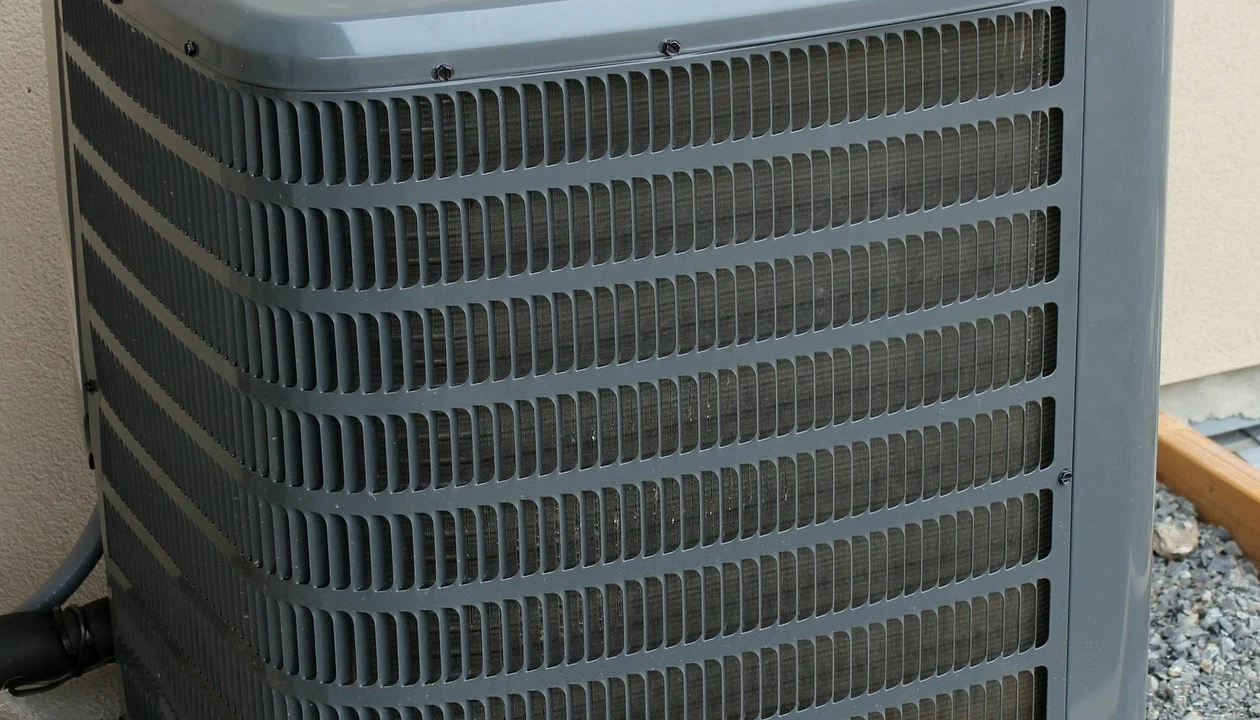
The outdoor unit pulls air through its coil to shed the heat taken out of your house. Anything that blocks that air makes it work harder. The sources agree on the task and differ on the distance:
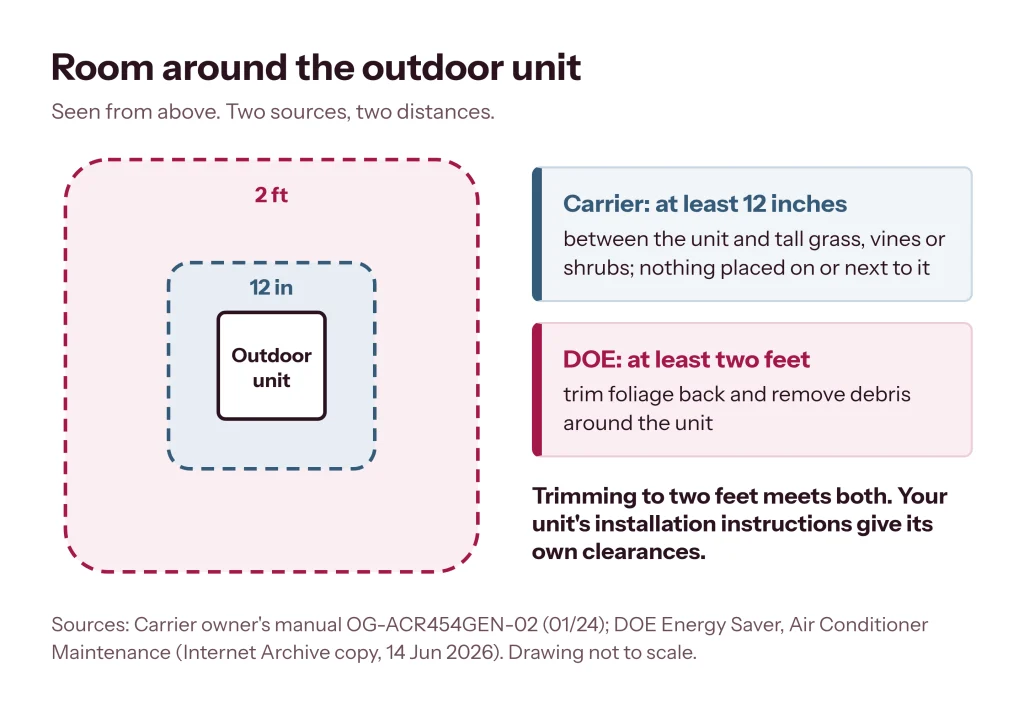
- DOE (archived): keep the area around the unit clean, remove debris, and “trim foliage back at least two feet”.
- Carrier OG-ACR454GEN-02: don’t place items on or next to the unit, don’t let grass clippings or leaves build up on its sides or top, and keep at least 12 inches between the unit and tall grass, vines or shrubs.
- Trane 32-5084-1B-EN: don’t plant flowers or shrubs right next to the unit, make sure nothing is stacked against its sides or draped over it, and clear snow from around it as soon as possible after it builds up.
Twelve inches is Carrier’s minimum for its units; two feet is DOE’s general advice. If you’re trimming anyway, two feet meets both. Your own unit’s installation instructions give its clearances; if you don’t have them, ask your installer.
Carrier adds two things owners often miss. Check for and remove debris that has settled around the base of the unit, so the base pan drains and water doesn’t stand inside it. And if the pad settles and the unit is no longer level, it should be re-leveled promptly. Carrier doesn’t say who does that, but since it keeps everything beyond the monthly items and rinsing for a qualified technician, call your installer rather than moving the unit yourself. If water or ice collects under the unit, Carrier says to arrange for it to drain away.
3. Rinse the outdoor coil with plain water
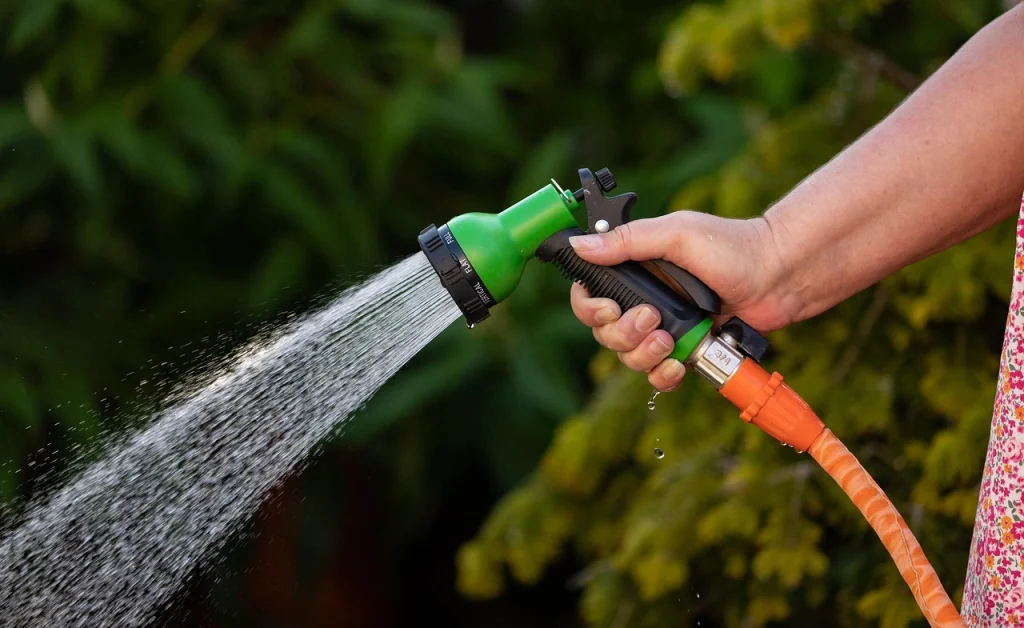
Carrier names “outdoor unit rinsing” as one of the jobs the owner may do, and adds a limit in the notes to its checklist: “Do not use harsh chemicals or high pressure water on coils” (OG-ACR454GEN-02, p. 2). So a garden hose, not a pressure washer, and no coil cleaners of your own. Before you rinse, switch the system off at the thermostat and at the outdoor disconnect, and keep the spray off the disconnect box and the wiring. You don’t need to remove any panel to rinse the coil from outside.
Near the sea it’s more often. Carrier suggests washing all exposed surfaces and the outdoor coil “approximately every 3 months” in coastal locations because of airborne salt, and to ask your installer about intervals for your area. Trane recommends a monthly fresh-water rinse for coastal locations, and cleaning the cabinet’s finish with soap and fresh water, never lacquer thinner or other solvents.
Bent fins are a different matter. DOE’s page says that “a qualified HVAC contractor” can use a fin comb to straighten them. Leave combing to the technician.
4. Watch the condensate drain
An air conditioner takes water out of the air. That water (condensate) drips off the indoor coil into a pan and runs out through a drain line, sometimes to a small pump. Carrier’s owner check is simple: after a few minutes of cooling, water should trickle from the condensate drain; check this occasionally (less water is normal in a very dry climate). Trane says condensate drains “should be checked and cleaned periodically” so water can flow freely from coil to drain, or water damage could occur.
Who cleans it is where the sources part. DOE’s archived maintenance page tells owners to “clear the unit’s drain channels periodically with a stiff wire”, and its archived common-problems page suggests periodically flushing the drain line “with bleach and water” to prevent mold (DOE, Common Air Conditioner Problems, archived 8 June 2026). Carrier puts cleaning the condensate pan, trap and drain lines on the technician’s yearly list, more often in humid climates. Read your own manual before pouring anything into the line. The step-by-step, with what each maker allows, is on how to clear a clogged AC drain line.
Why it matters: a blocked drain can make the equipment shut off until the drain is cleared, or overflow and damage the house (DOE). The model building code, the 2024 International Residential Code, asks for a secondary drain, an extra drain pan, or a water-level switch that shuts the unit off where an overflow would damage the building (IRC 2024, M1411.9.1 and M1411.9.1.1). That’s the model code; your local building department decides what applies to your house. Ask your technician which one your system has.
5. Keep vents and returns open
Carrier asks owners not to block floor, wall or ceiling vents with drapes, furniture or toys, because restricted airflow lowers the system’s efficiency and life span. Trane’s first check for weak cooling is the same: dirty filters, supply registers or return grilles blocked, or a blocked outdoor coil. DOE’s common-problems page adds: keep interior doors open so air can circulate.
6. The thermostat and the first warm day
ENERGY STAR’s tune-up list starts with the thermostat settings, and Carrier’s troubleshooting list gives them as an owner check: for cooling, the System or Mode control on Cool or Auto and the set temperature lower than the room temperature the thermostat shows (Carrier). Trane suggests using the fan only on Auto when indoor humidity is above 60% or feels uncomfortably humid.
Test the cooling on a warm day. Carrier’s manual says its outdoor unit “is not designed to operate when outdoor temperatures are lower than 55°F/13°C without modification”. Don’t be alarmed by a pause before the outdoor unit starts: Carrier says some air conditioners have built-in time delays that protect the equipment. Lennox’s M30 thermostat, for one, has a 5-minute delay between cooling cycles (Lennox 507739-02, 3/2025). Other thermostats may differ.
If nothing runs, the makers’ first checks are the indoor and outdoor disconnect switches, the breakers or fuses in the main panel, and the thermostat (Carrier; Trane). DOE’s archived common-problems page says to let the unit cool for five minutes before resetting a tripped breaker. A breaker that trips again is a stop: leave it off and call.
7. Winter covers: the sources disagree
DOE’s archived page says to cover the outdoor unit of a central air conditioner in winter to protect it from weather and debris, and if you’re unsure, to ask a qualified HVAC contractor. Carrier’s owner manual says the opposite in plain words: “Do not cover it”. Trane says nothing should be draped over the unit. One point is clear: if your outdoor unit is a heat pump, which heats as well as cools, DOE says not to cover it, because a cover stops it heating the house properly. Follow your own unit’s manual; if it says not to cover, don’t.
What to leave to the technician, and why
- Anything behind a panel on the outdoor unit. The capacitor (which stores a charge to start the compressor and fan motor) and the contactor (the switch that turns them on) sit there. The makers keep this work for a technician, and a capacitor can hold its charge after the power is off.
- The indoor coil. Carrier says the indoor coil sits in a sealed cabinet and needs little cleaning if the filter is kept up; longer run times and lower efficiency “may indicate the need for a coil cleaning by your authorized dealer”. DOE also puts the indoor coil with the contractor.
- Straightening fins with a fin comb (DOE: a qualified HVAC contractor).
- The refrigerant. Federal law, below.
- The leak sensor on a newer system. Newer systems using the mildly flammable refrigerants of class A2L (R-454B and R-32) can carry a refrigerant leak sensor; Carrier’s R-454B air conditioners do. Carrier’s checklist has the technician inspect the leak dissipation system once a year, wipe or vacuum dust off the sensor and press the test button on its control board. Never disconnect or bypass it. Lennox’s furnace instructions say disabling refrigerant detection on an A2L system “is prohibited by safety codes” (Lennox 508547-01, 12/2025).
The yearly tune-up checklist
ENERGY STAR recommends an annual pre-season check-up by a contractor, the cooling side in spring and the heating side in fall, because contractors get busy once summer and winter arrive. Trane says the system should be inspected at least once a year by a properly trained technician. Here is what a tune-up on the cooling side should cover, with the source for each item, so you can compare it with what a visit actually included.
| Item | Why | Source |
|---|---|---|
| Clean the evaporator and condenser coils | Dirty coils cut cooling and make the system run longer | ENERGY STAR; Carrier |
| Check the refrigerant charge and test for leaks | Too much or too little refrigerant lowers efficiency; a low charge means a leak or an undercharge at install | ENERGY STAR; DOE (archived); Carrier: subcooling or superheat |
| Capture any refrigerant taken out | Releasing it is illegal | DOE (archived); 40 CFR 82.154(a) |
| Tighten electrical connections; measure voltage and current on motors | Faulty connections can cause unsafe operation and shorten the life of parts | ENERGY STAR; DOE; Carrier |
| Check the disconnects work | Power must really be off when it’s switched off | Carrier |
| Inspect the outdoor fan and motor; make sure the fan spins freely | Fan failure stops the outdoor coil shedding heat | Carrier |
| Lubricate moving parts; oil motors and check belts, where fitted | Friction raises electricity use | ENERGY STAR; DOE |
| Clean and adjust the blower; measure airflow across the indoor coil | Airflow problems can cut efficiency by up to 15% | ENERGY STAR; DOE; Carrier |
| Clean the condensate pan, trap and drain line | A plugged drain can cause water damage and affect indoor humidity | ENERGY STAR; Carrier |
| Check the controls and the start-up cycle | The system should start, run and shut off properly; heating and cooling must not run at the same time | ENERGY STAR; DOE |
| Check the thermostat’s settings and accuracy | Comfort and energy use | ENERGY STAR; DOE |
| Inspect ductwork for leaks | Leaky ducts lose cooled air | DOE; Carrier |
| Inspect the cabinet; replace damaged or badly rusted parts | Protects the coil and wiring | Carrier |
| A2L systems: inspect the leak sensor and test the dissipation control | The safety system must work | Carrier |
If your indoor unit is a gas furnace, the heating side has its own checks (burner, gas connections, heat exchanger, venting) and its own season. They’re on furnace maintenance.
The refrigerant: what the technician does, and why it’s theirs
Refrigerant moves heat from the indoor coil to the outdoor coil in a sealed loop. DOE’s archived common-problems page explains what a low charge means: if a system is low on refrigerant, either it was undercharged at installation or it leaks, and a trained technician should fix the leak, test the repair and then charge the system correctly.
To check the charge, the technician measures temperatures and pressures (Carrier’s checklist names subcooling or superheat, depending on the system). Attaching gauges is itself work on the refrigerant circuit. Under Section 608 of the Clean Air Act, EPA’s rule says anyone who could be “reasonably expected to violate the integrity of the refrigerant circuit” is a technician, and lists attaching or detaching hoses and gauges, adding or removing refrigerant, adding or removing components and cutting a refrigerant line. Painting the unit, rewiring an external circuit, replacing pipe insulation or tightening nuts and bolts are not (40 CFR 82.152). The rule names owners among those who can be technicians: there is no homeowner exemption.
- Certification. Central air conditioners are covered by a Type II (or Universal) certification (40 CFR 82.161). “EPA does not issue certification cards” itself (EPA, Section 608 certification, updated 3 March 2026), so the card a technician carries comes from a certifying program.
- No venting. No one servicing a system may knowingly release refrigerant (40 CFR 82.154(a)), which is why DOE’s list has the technician capture any refrigerant taken out.
- No sales to homeowners. “Only Section 608 certified technicians can purchase refrigerants intended for use with stationary refrigeration and air-conditioning equipment.” The small-can exemption is for car air conditioning (EPA, refrigerant sales restriction, updated 23 March 2026). A store-bought can is not a home AC top-up.
- No federal duty to fix a home AC leak. EPA’s leak-repair rule for larger systems does not apply to residential air conditioning (40 CFR 84.106(a)(3)(ii)). So whether a leak is found and fixed, or refrigerant is only added, is a choice made between you and the technician. Ask which it is.
Which refrigerant your system uses is printed on the outdoor unit’s rating plate. It matters for repair choices: R-22 hasn’t been produced or imported in the US since 1 January 2020, though existing systems may keep using it (EPA-430-FR-20001); EPA’s restriction on R-410A, in force since 1 January 2025, is on installing new systems, not on servicing existing ones, and even new systems may still be installed where all their specified components were made or imported before 2025 (40 CFR 84.54(c)(1)); and many new systems use R-454B or R-32. Signs of a leak and the questions to ask are on AC refrigerant leak.
Before the visit: what to write down and what to ask
Carrier’s manual suggests having the model and serial numbers of both units ready when you call, from the rating plates on the indoor and outdoor units; with them, it says, a dealer may be able to help over the phone or prepare for the visit. Write down too:
- the refrigerant type on the outdoor unit’s plate, and the year it was installed if you know it;
- anything you’ve noticed: longer run times, weak airflow, water near the indoor unit, ice on the lines, a new noise, a breaker that tripped;
- your filter size and when you last changed it.
Questions worth asking at the end:
- Which items on the checklist did you do, and what did you find? Can I have it in writing?
- Did you connect gauges? If you added refrigerant, how much, which type, and was a leak found?
- Is there a leak you recommend repairing, rather than a top-up?
- Does my system have an overflow switch or a secondary drain pan, and does it work?
- What filter size and rating suits my system?
- If a part is failing, is it under warranty? Trane notes that its registered warranty terms apply if the product was registered within 60 days of installation, with a separate rule for Florida residents, so check your own paperwork.
Trane and Carrier both mention service agreements that cover seasonal inspections. Whether one is worth it depends on its terms; read what’s included against the checklist above.
When maintenance turns into a repair call
Stop the owner checks and call a technician if:
- there’s ice on the refrigerant lines or the indoor coil: switch the cooling off and see AC frozen for the thaw steps;
- a breaker or fuse trips again after a reset;
- water is on the floor or near wiring, or the drain won’t clear;
- there’s an unusual noise (Trane: “Call your local servicer”), or the outdoor unit hums but its fan doesn’t turn;
- you smell burning from wiring: switch the system off at the thermostat and breaker and call.
If a tune-up turns up a big repair on an older system, ENERGY STAR suggests considering replacement for an air conditioner “more than 10 years old” (ENERGY STAR, when to replace). That’s a prompt, not a lifespan. Our repair or replace checklist lays the points out with your own quotes.
Your next step
Today: find your filter and look at it, walk round the outdoor unit and clear anything within two feet, and copy the model, serial and refrigerant type from both rating plates into a note on your phone. On the next warm day, run the cooling and look for water trickling from the condensate drain. Book the yearly check for spring, take the checklist above with you, and ask for a written list of what was done. Some things can’t wait for spring: a gas smell, a carbon monoxide alarm, or a burning smell from wiring.
Sources checked on 10 November 2026: Carrier OG-ACR454GEN-02 (edition 01/24), Trane 32-5084-1B-EN (2024), Lennox 507739-02 (3/2025) and 508547-01 (12/2025), ENERGY STAR maintenance checklist and replacement page, DOE Energy Saver pages (Internet Archive copies of 8 and 14 June 2026; the live pages returned “not found”), EPA Section 608 pages and air cleaner guide, EPA’s R-22 fact sheet EPA-430-FR-20001, eCFR 40 CFR 82.152, 82.154, 82.161, 84.54 and 84.106 and 29 CFR 1910.333, the 2024 IRC (model code) and PHMSA and CPSC safety pages. Makers’ manuals speak for their own products; check yours.
Sources
- Carrier: Owner's Manual, Split-System Air Conditioner Using R-454B Refrigerant, Catalog No. OG-ACR454GEN-02 (edition 01/24)
- Trane: Air Handlers, Heat Pumps and Air Conditioners – Owner's Guide, Doc. 32-5084-1B-EN (2024)
- ENERGY STAR: Maintenance Checklist
- ENERGY STAR: When to replace your heating and cooling equipment
- DOE Energy Saver: Air Conditioner Maintenance (Internet Archive copy, 14 Jun 2026; live page 404 on 10 Nov 2026)
- DOE Energy Saver: Common Air Conditioner Problems (Internet Archive copy, 8 Jun 2026)
- EPA: Guide to Air Cleaners in the Home (updated 1 Oct 2026)
- eCFR: 40 CFR 82.152, Definitions (technician)
- eCFR: 40 CFR 82.154, Prohibitions (venting, sales restriction)
- eCFR: 40 CFR 82.161, Technician certification
- eCFR: 40 CFR 84.54, Restrictions on new products (R-410A systems)
- eCFR: 40 CFR 84.106, Leak repair (residential AC excluded)
- EPA: Refrigerant Sales Restriction (updated 23 Mar 2026)
- EPA: Section 608 Technician Certification (updated 3 Mar 2026)
- EPA: Residential Air Conditioning and the Phaseout of HCFC-22, EPA-430-FR-20001 (Feb 2020)
- Lennox: M30 Smart Thermostat Installation and Setup Guide, 507739-02 (3/2025)
- Lennox: ML180UHVK Gas Furnace Installation Instructions, 508547-01 (12/2025)
- eCFR: 29 CFR 1910.333 (stored electric energy)
- PHMSA: Natural gas emergencies
- CPSC: Carbon Monoxide Questions and Answers