A gas furnace that blows cold air is usually doing one of three things. It may be behaving normally: it is still warming up, it is finishing a cycle, or the thermostat fan is set to ON. It may have shut its burners off for safety while the blower keeps running, most often because a dirty filter or blocked airflow let it overheat. Or it may have failed to light, or to keep a flame, and locked itself out. On some new furnaces there is a fourth reason: a refrigerant leak sensor has turned the gas heat off and is running the fan on purpose. The checks below come from the makers’ own manuals, in the order that rules out the easy causes first. This page is part of our guide to furnace problems.
If you smell gas: leave the house now. Don’t switch lights or appliances on or off, don’t use a phone inside, and don’t try to find the leak. From outside or a neighbour’s home, call 911 or your gas utility’s emergency line (PHMSA, natural gas emergencies). If you heat with propane, Trane’s owner guide warns that odorant can fade so the gas may not be smelled at all: don’t rely on smell alone, and a gas detector helps (Trane, Gas Heating Systems Owner’s Information, 32-5083-1C-EN, 2024).
If a carbon monoxide alarm sounds: get everyone outside into fresh air, call 911 or the fire department from outside, and don’t go back in until responders say it’s safe (CPSC, carbon monoxide questions and answers). Headache, dizziness, weakness, nausea, chest pain or confusion that eases away from home can be carbon monoxide (CDC). Don’t run the furnace again until a technician has checked it. More in carbon monoxide and your furnace.
If the furnace has been under water, don’t use it. Carrier and Trane both say a flood-damaged furnace is extremely dangerous and that a qualified service agency should inspect it and replace the gas controls and electrical parts that got wet (Carrier owner’s manual 80GSFRN-B-03OM, Edition 08/22, p. 2; Trane 32-5083-1C-EN).
General information, not professional advice. Your system’s maker, your manual and a qualified technician decide what’s safe for your equipment, and local codes decide what needs a permit or a licensed installer.
When cool air is normal
Some cool air is built into the way a furnace works. Before you look for a fault, rule these out:
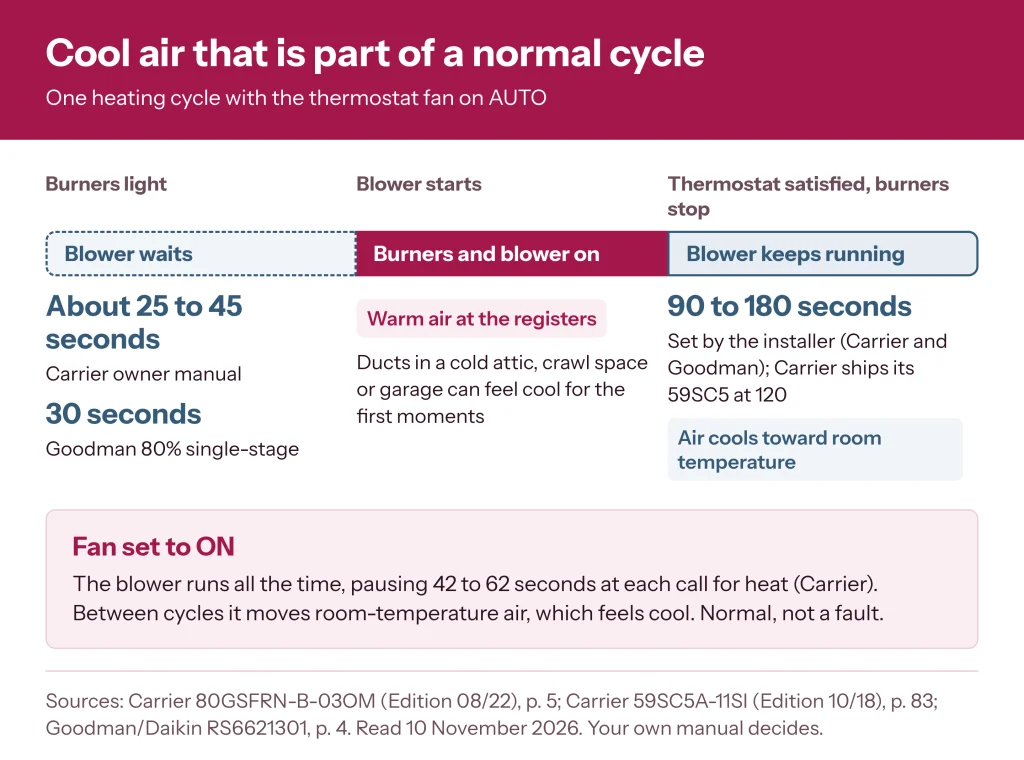
- The first half-minute or so. A modern furnace lights its burners first and starts the blower only once the heat exchanger (the metal box the flames heat, which the house air passes over) has warmed up. Carrier’s owner manual puts that delay at about 25 to 45 seconds after the burners light (80GSFRN-B-03OM, p. 5). Goodman’s service manual for its 80% single-stage furnaces gives a fixed 30-second delay (Goodman/Daikin RS6621301, p. 4). Air sitting in ducts that run through a cold attic, crawl space or garage can also feel cool for the first moments.
- The end of a cycle. When the thermostat is satisfied the burners stop, but the blower keeps running to pull the leftover heat out of the heat exchanger. Carrier and Goodman both let the installer set this from 90 to 180 seconds; Carrier ships its 59SC5 furnace at 120 (Carrier 59SC5A-11SI, Edition 10/18, p. 83; Goodman RS6621301, p. 4). The air cools toward room temperature as that runs out.
- The thermostat fan set to ON. On AUTO, the blower runs only while the furnace is heating. On ON, Carrier says the blower runs all the time, stopping only for a 42 to 62 second pause at each call for heat (80GSFRN-B-03OM, p. 5). Between heating cycles it moves room-temperature air, and air moving across your skin feels cool. That is normal, not a fault. Trane’s start-up steps finish with the fan set to AUTO (32-5083-1C-EN).
- Right after a power cut. Carrier’s 59SC5 runs the blower alone for 90 seconds when power returns during a call for heat, flashing code 12, before it starts heating normally (59SC5A-11SI, pp. 83 and 85).
If the air stays cool for minutes on end while the thermostat is calling for heat, something else is going on.
What the pattern tells you
| What you notice | Likely reason | Where to go |
|---|---|---|
| Cool air between heating cycles, warm air during them | Fan set to ON | You check, step 1 |
| Heat for a while, then cool air for several minutes, then heat again | Burners shutting off on the high limit, usually low airflow | Limit trips |
| Burners light, go out within seconds, then the blower runs cool air for a minute or more | Flame not proved (a dirty flame sensor is one cause), or a pressure switch opening | Flame and ignition |
| Blower runs nonstop, no burners at all | Limit or rollout switch open, or a refrigerant leak sensor at work | Limit trips, leak sensors |
| Air is warm, but the house never reaches the setting | Airflow, ducts, or the furnace cycling on its limit | Not keeping up |
You check
These are the checks the makers print for owners. Goodman, Lennox and Trane tell owners not to service the unit, and Trane says do-it-yourself repairs on an in-warranty unit may void the warranty. If you’re not comfortable, or the code comes back, stop and call a technician. Carrier’s owner manual sums up the owner’s part: untrained people can clean or replace air filters, and everything else is for trained service personnel (80GSFRN-B-03OM, p. 3).
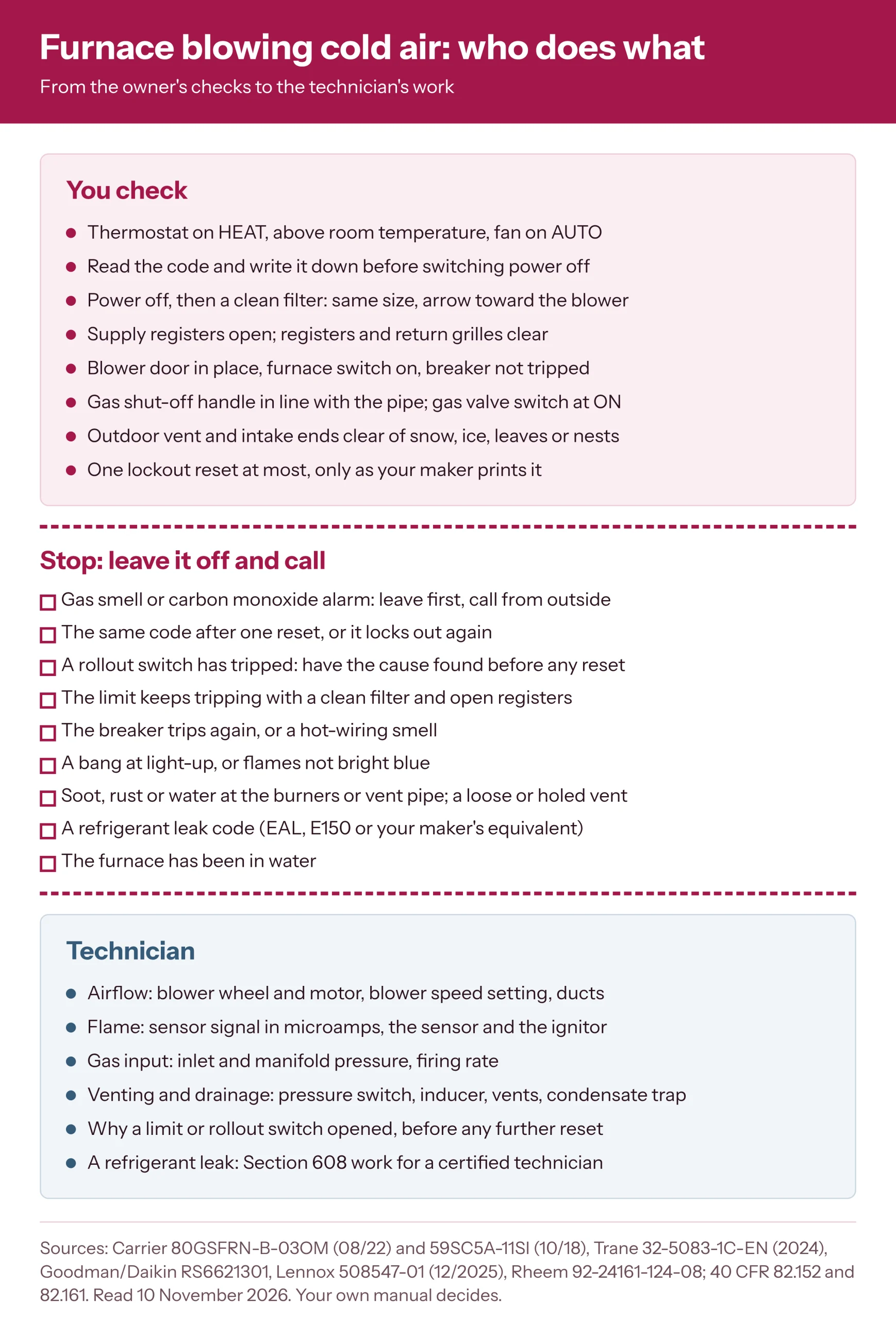
- The thermostat. Is it set to HEAT, and above the room temperature (Carrier, 80GSFRN-B-03OM, p. 7)? Set the fan to AUTO and wait through one full cycle. If the cool air was only between cycles, you’ve found it. If the screen is blank, see furnace not turning on first.
- The filter. If your furnace has a status light or code display (step 7), write down what it shows first. Then turn the furnace off at its power switch: Carrier’s filter steps start with the electrical supply off, and Goodman’s manual says to disconnect all power before removing the filter and warns that there may be more than one power source (Goodman RS6621301, p. 11). Goodman calls poor filter care “the most common cause” of weak heating or cooling (p. 11). Carrier says a dirty filter can make the furnace overheat and shut itself down (80GSFRN-B-03OM, p. 5). Replace it with the same size and type, arrow pointing toward the blower, and never run the furnace without one. How often depends on the maker and the filter: see how often to change a furnace filter.
- Registers and return grilles. Open the supply registers, and clear furniture, rugs and boxes from them and from the return grilles. Both Carrier (80GSFRN-B-03OM, p. 7) and Trane (owner’s table, “insufficient heating”) put this before a service call.
- Doors and power. Is the blower door firmly in place, the furnace power switch on, and the breaker not tripped (Carrier, p. 7)? Trane says its furnaces may have a door switch that cuts power to the blower and gas valve when the door is off, and that the unit must not be altered to run with that door removed (32-5083-1C-EN). A breaker that trips again is a stop, not something to keep resetting.
- The gas supply. Carrier’s owner checks: the manual shut-off valve in the gas pipe to the furnace is open when its handle runs the same way as the pipe, and closed when it sits at a right angle. Then, with the furnace power off and the access door removed, the switch on the gas valve should be at ON (80GSFRN-B-03OM, p. 7). If you find the gas was off, Carrier says to make sure it wasn’t shut off for safety reasons, then follow the start-up steps on the label inside the furnace door. Those steps include waiting 5 minutes and smelling for gas, near the floor too, before turning the gas back on (pp. 3 to 4). If the gas line itself is off, Trane’s table says to have the gas company check it. If you’re on propane and the tank has run out, call your propane supplier.
- The vent and intake pipes outside. On a high-efficiency furnace with plastic pipes through the wall or roof, make sure the ends outside aren’t blocked by snow, ice, leaves or a nest. Trane’s owner table lists blocked vent terminals as a cause of “no heat” with the inducer (vent) motor running, and its manual says the terminals must not be obstructed in any season (32-5083-1C-EN). Don’t take the pipes apart.
- The code. Many furnaces have a status light or display on the control board, often visible through a small window in the blower door. Read it before you switch the power off, so you have it written down: Carrier’s 59SC5 keeps its last code but erases it after 72 hours (59SC5A-11SI, p. 85), and boards differ. Carrier’s two-digit amber LED, Goodman’s E-codes and Lennox’s four-character E-codes each mean different things: look yours up in our furnace error code lookup, and check it against the label inside your furnace door, which decides for your board.
- One lockout reset, only as your maker prints it. Trane’s owner table gives one: for a lockout, “Turn power on-off-on-off twice in 30 seconds” (32-5083-1C-EN). Carrier’s owner manual is stricter: if the furnace locks out, or the blower doesn’t come on, shut it down and call your dealer (80GSFRN-B-03OM, p. 5). Carrier’s installation manual for its 59SC5 condensing furnace adds that on that model a lockout resets itself after three hours (59SC5A-11SI, p. 83). If the furnace locks out again, stop.
Limit trips: burners off, blower still running
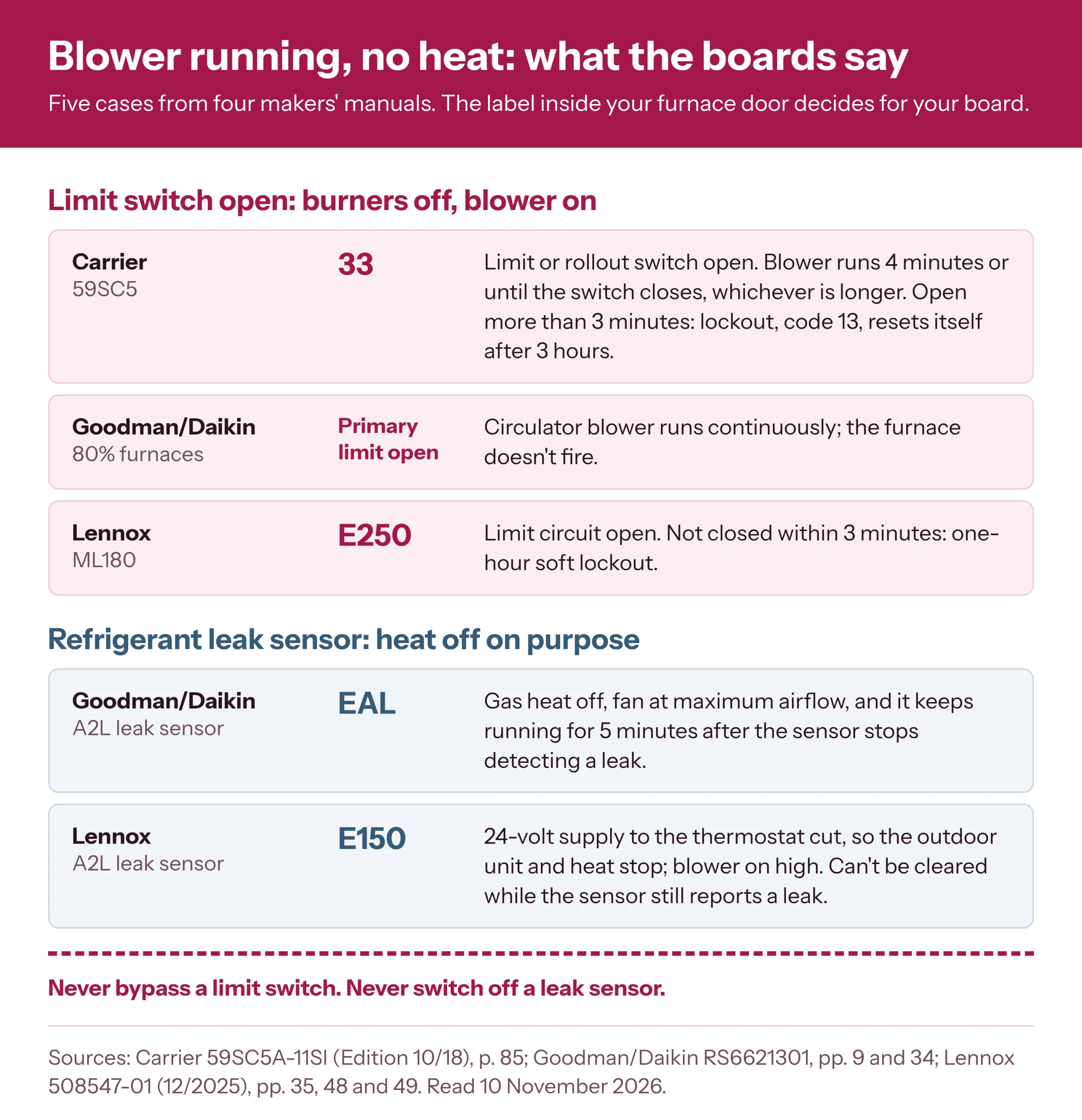
This is the classic “furnace blowing cold air”. Every furnace in the manuals we read has a limit switch, a heat-sensitive switch near the heat exchanger. If the furnace gets too hot, it cuts the gas. The blower keeps running to cool things down, so you get air but no heat. The makers describe it like this:
- Carrier 59SC5, code 33: the limit or flame rollout switch is open, and the blower runs for 4 minutes or until the switch closes again, whichever is longer. If it stays open more than 3 minutes, the furnace locks out (code 13) and resets itself after 3 hours. Carrier’s troubleshooting guide lists causes including a dirty filter or restricted ducts, a loose blower wheel, the wrong gas input and a faulty switch (59SC5A-11SI, p. 85).
- Goodman/Daikin 80% furnaces: with the primary limit open, the circulator blower runs continuously and the furnace doesn’t fire. Goodman’s chart blames too little air over the heat exchanger: blocked filters, restrictive ductwork, the wrong blower speed or a failed blower motor (RS6621301, p. 34).
- Lennox ML180, code E250: limit circuit open. If it hasn’t closed within 3 minutes, the furnace goes into a one-hour soft lockout (Lennox 508547-01, 12/2025, p. 49).
- Trane: inadequate airflow can make the furnace cycle on and off as the limit trips and resets, and if you suspect that, Trane says to contact a qualified service technician straight away (32-5083-1C-EN).
The owner’s part is the filter, the registers and the returns. If those are clear and it still trips, the cause is inside the furnace or the ducts, which is the technician’s job. Never jump, bypass or disable a limit switch: Goodman’s service manual says plainly not to bypass any safety limit connection (RS6621301, p. 19).
The rollout switch is different. A flame rollout switch trips when flames come out of the burner area instead of being drawn into the heat exchanger. On many furnaces it has a small reset button and stays off until someone presses it. Goodman says the blower runs continuously once it opens (RS6621301, p. 20). The makers disagree about owners pressing the button. Carrier’s owner manual says to push the button once, and if it trips a second time, turn the furnace off and call for service (80GSFRN-B-03OM, p. 7). Trane says the cause “must be investigated by a qualified service technician” (32-5083-1C-EN). Rheem’s installation manual calls a rollout trip a very serious problem that must be repaired before the furnace runs again (Rheem 92-24161-124-08, fault 33). Trane describes the trip as flames not being properly drawn into the heat exchanger, and Goodman adds over-firing, so it is a combustion problem, not an airflow one. Follow your own maker’s line, never press it more than once, and make sure a working CO alarm is on every level.
Flame and ignition: lights, then goes out
After the gas valve opens, the furnace has a few seconds to “prove” the flame through the flame sensor, a thin metal rod in the burner flame. No proof, no gas: the valve closes and the control tries again. Carrier’s 59SC5 allows four tries, then locks out with code 14. If the flame is lost during the blower-on delay, the blower comes on and runs through its full 90 to 180 second off-delay (59SC5A-11SI, pp. 83 and 85). You hear the burners light, they go out, and a minute or more of cool air follows. Lennox reports low flame current as E240, with the action “clean or replace sensor” (508547-01, p. 49). Goodman shows a lockout after three failed tries as EE0 and a low flame signal as EE6 (RS6621301, pp. 34 and 41).
A dirty flame sensor is one cause the makers list: Goodman’s chart says to check the flame signal and clean a coated sensor for EE0 (RS6621301, p. 34). It isn’t the only one. Carrier’s list starts with the gas valve switch turned off and the manual shut-off valve closed, then the ground wire and the sensor itself (59SC5A-11SI, p. 85). Carrier’s sensor-cleaning procedure is written for a qualified service technician and involves disconnecting the gas pipe at the valve (59SC5A-11SI, pp. 78 to 79). Our furnace flame sensor page covers what each maker says, step by step. A pressure switch that won’t stay closed has a similar pattern. Carrier’s code 31 lists a plugged condensate drain, blocked or disconnected tubing, a restricted vent, strong wind, and a faulty inducer motor or low voltage to it (59SC5A-11SI, p. 85). If the furnace lights and stops over and over, see also furnace short cycling.
Newer systems: the refrigerant leak sensor
Air conditioners that use the newer refrigerants R-454B and R-32 (both listed as class A2L in EPA’s SNAP table) can have a leak sensor at the indoor coil, which sits on top of or beside the furnace. On the Goodman and Lennox furnaces whose manuals we read, that sensor is wired to the furnace’s control board. When that sensor detects refrigerant, the furnace control turns off the gas heat and runs the blower hard to dilute it. In winter that looks exactly like a furnace blowing cold air, and it is the furnace doing its job.
- Goodman/Daikin shows EAL (A2L refrigerant leakage), shuts down gas heat, runs the fan at maximum airflow, and keeps it running for 5 minutes after the sensor stops detecting a leak before going back to normal (RS6621301, p. 9).
- Lennox shows E150. The control cuts the 24-volt supply to the thermostat, which turns off the outdoor unit and the heat, and runs the blower on high to purge refrigerant from the cabinet and ducts. The code can’t be cleared while the sensor still reports a leak (508547-01, pp. 35 and 48). Lennox notes that some thermostats lose their settings after this, and heat could be lost on a cold night (p. 36).
Let it run, and don’t try to switch the sensor off: Lennox says disabling refrigerant detection on an A2L system “is prohibited by safety codes” (508547-01, p. 1). Finding and fixing the leak means opening the refrigerant circuit. Under federal Section 608 rules, anyone who could open that circuit, for example by attaching gauges or adding refrigerant, must be certified, and the rule says technicians can include the owners of the equipment (40 CFR 82.152 and 82.161; EPA, Section 608 technician certification). More on these refrigerants in R-454B and R-32.
One more case, on newly installed furnaces. Lennox’s installation manual warns that when its furnace goes in without an A2L air conditioner, the installer must set the leak-sensor switches to disabled, “otherwise the blower will operate continuously” (508547-01, p. 34). Goodman’s board has the same feature switched on by default and says it must be turned off if the paired cooling unit doesn’t use R-32 (RS6621301, p. 9). If a furnace put in recently runs its blower nonstop, ask the installer to check that setting. Don’t change it yourself: only the installer knows which refrigerant your system uses.
Warm air, but not keeping up
Sometimes the air at the register is warm and the house still falls behind the thermostat. Trane’s owner table has this exact symptom, “insufficient heating, blower operates continuously”, and lists two causes for the owner to check: dirty filters, then blocked supply or return registers (32-5083-1C-EN). After that:
- Leaky or loose ducts. ENERGY STAR says that in a typical house about 20 to 30 percent of the air moving through the ducts is lost to leaks, holes and poorly connected ducts. That makes a house hard to keep comfortable “no matter how the thermostat is set”. It points to ducts in an attic, crawl space or garage, and to rooms that are hard to heat (ENERGY STAR, Duct Sealing, read 10 November 2026). A duct that has come apart in an unheated space can dump warm air there and leave one room cold.
- A furnace cycling on its limit. If the burners keep shutting off early, the house gets less heat than the furnace is rated for. That’s the limit pattern above, and Trane wants a technician to look at it.
- The weather. On the coldest nights a furnace can run for long stretches. If it keeps up on milder days and falls behind only in a deep cold snap, tell the technician the outdoor temperature when it happened. That helps separate a fault from a furnace working flat out.
Stop
Stop, leave the furnace off and call a technician (or 911 and the gas utility, from outside, for gas or CO) when:
- you smell gas, or a CO alarm sounds;
- the same code comes back after one reset, or the furnace locks out again;
- a rollout switch has tripped (have the cause investigated before any reset, even where your manual prints one, and never reset it twice);
- the limit keeps tripping with a clean filter and open registers;
- the breaker trips again, or you smell hot wiring;
- the burners make a loud bang when they light (Carrier says to shut down and call, 80GSFRN-B-03OM, p. 7), or the flames aren’t burning bright blue (Carrier and Trane both say they should be);
- you see soot, rust or water around the burners or the vent pipe, or the vent pipe is loose or has holes;
- the control shows a refrigerant leak code (EAL, E150 or your maker’s equivalent);
- the furnace has been in water.
What the technician checks
- Airflow: blower wheel and motor, the blower speed the installer set, filter location and the ducts. These are the causes Carrier and Goodman list for limit trips.
- Flame: the flame sensor’s signal in microamps, a reading Lennox and Carrier both use, then cleaning or replacing the sensor, and the ignitor.
- Gas input: inlet and manifold gas pressure and the firing rate. Carrier and Lennox both list the gas input or firing rate among the causes of a limit trip. This is technician-only work.
- Venting and drainage: the pressure switch and its tubing, the inducer, the vent pipes and, on a condensing furnace, the condensate trap and drain.
- Safety switches: why a limit or rollout switch opened, before any further reset (Trane: such trips “must be investigated”). Lennox’s annual check includes the heat exchanger, a combustion analysis and the A2L sensor (508547-01, p. 41).
- The refrigerant side, if a leak sensor tripped: finding and repairing the leak is Section 608 work for a certified technician.
Your next step
Right now: set the thermostat to HEAT with the fan on AUTO, put in a clean filter, open the registers and watch one full cycle. If it still blows cold, write these down before you call. A good description saves the technician time, and Carrier notes that the dealer may be able to help over the phone if you give the model and serial number (80GSFRN-B-03OM, p. 7):
- the code or flash pattern on the control board, read before you switch the power off;
- the model and serial number from the rating plate inside the furnace door;
- the pattern: cool air all the time, after a few minutes of heat, or right after the burners light and go out;
- whether the air conditioner was replaced recently, and whether it uses R-454B or R-32;
- the outdoor temperature, and whether this happened before.
Ask what tripped and why, whether the fix is a cleaned part or a new one, and whether the part is under warranty. What can’t wait: a gas smell, a CO alarm, or a burning smell from wiring. Check that you have a working carbon monoxide alarm on every level of the home and outside sleeping areas, as CPSC advises.
Sources checked on 10 November 2026: Carrier 80GSFRN-B-03OM (Edition 08/22) and 59SC5A-11SI (Edition 10/18); Goodman/Daikin RS6621301; Lennox 508547-01 (12/2025); Trane 32-5083-1C-EN (2024); Rheem 92-24161-124-08; PHMSA, CPSC, CDC, ENERGY STAR and EPA pages as linked; 40 CFR 82.152 and 82.161 in the eCFR. Makers’ manuals describe their own furnaces; yours may differ, so read the label inside your furnace door.
Sources
- Carrier, Non-Condensing 80% AFUE Gas Furnace Owner's Manual, Catalog No. 80GSFRN-B-03OM, Edition 08/22
- Carrier, 59SC5 Single-Stage Condensing Gas Furnace Installation, Start-up, Operating and Service and Maintenance Instructions, Catalog No. 59SC5A-11SI, Edition 10/18
- Goodman/Daikin, Service and Troubleshooting, 80% Single Stage Gas Furnaces, RS6621301 (2023)
- Lennox, ML180UHVK Merit Series Gas Furnace Installation Instructions, 508547-01 (12/2025)
- Trane, Gas Heating Systems – Owner's Information, Doc. 32-5083-1C-EN (2024)
- Rheem, Installation Instructions, (-)96V and (-)(-)96MDV Gas Furnaces, 92-24161-124-08
- PHMSA, Recognizing and Responding to Pipeline Emergencies
- CPSC, Carbon Monoxide Questions and Answers
- CDC, Carbon Monoxide Poisoning Basics
- ENERGY STAR, Duct Sealing
- EPA, Section 608 Technician Certification (updated 3 March 2026)
- eCFR, 40 CFR 82.152 Definitions (technician)
- eCFR, 40 CFR 82.161 Technician certification
- EPA, Substitutes in Residential and Light Commercial Air Conditioning and Heat Pumps (SNAP)