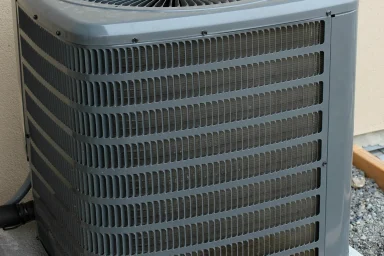
Looking after a central air conditioner and a gas furnace comes in two parts, and the makers whose manuals we read draw the line in much the same place. Your part is short and done by hand: the air filter, clear space around the furnace and the outdoor unit, open vents and return grilles, a plain-water rinse of the outdoor coil, a look at the condensate drain, snow kept off the furnace’s vent pipes, and tested carbon monoxide alarms. The technician’s part is everything behind a panel, on the gas side or on the refrigerant circuit, checked once a year. Carrier’s furnace instructions put it in one line: untrained people can clean and replace filters, and all other operations belong to trained service personnel. The five guides here set out both lists and show where the sources disagree.
General information, not professional advice. Your system’s maker, your manual and a qualified technician decide what’s safe for your equipment, and local codes decide what needs a permit or a licensed installer.
Before any maintenance job
- Gas smell: don’t start. Leave the house, don’t switch anything on or off or use a phone inside, and call 911 or your gas utility from outside or a neighbor’s home (PHMSA).
- Carbon monoxide alarm: get everyone outside, call 911 or the fire department from there, and don’t look for the source first (CPSC).
- Power off, in more than one place. Carrier, Goodman and Trane all warn that there may be more than one power source or disconnect. The outdoor unit runs on high-voltage household power, and its capacitor can hold a charge after the power is off: nothing in this section asks you to open a panel on it.
- A furnace that has been under water is not dried out and restarted. Carrier, Lennox and Trane all say not to use it until a qualified service agency has inspected it and replaced the wet gas controls and electrical parts.
- Hands off the refrigerant circuit. Under federal law, anyone who attaches gauges, adds or removes refrigerant or cuts a line counts as a technician and must be EPA-certified, owners included.
1. Start with the filter
The filter is the one job every maker gives the owner, and the one that matters most. Goodman calls dirty filters the most common cause of poor heating or cooling. In winter a clogged filter can make the furnace overheat and shut itself off on its limit switch; in summer it can let the indoor coil freeze.
How often to change it is where the sources spread out. ENERGY STAR says to inspect, clean or change filters once a month; Trane says every month for disposable filters; Goodman says every two months; EPA sums up makers’ advice as every 60 to 90 days; and deep media filters, 4 or 5 inches thick, last longer. There is no federal rule. Look monthly, and change it on your manual’s interval or sooner if it’s grey. How often to change a furnace filter, and which size puts every interval side by side, explains how to read the size on the frame, and shows which way the airflow arrow goes. Never run the system without a filter, not even for a day.
The rating on the frame is a separate question. MERV 8 has no required catch of the finest test particles; MERV 11 must catch at least 20% of them and MERV 13 at least 50%. EPA says most systems can take MERV 13 if it’s changed often, while Lennox warns that a higher rating than the installer’s may restrict airflow. MERV 8 vs 11 vs 13 sets both sides out and lists the signs to watch if you move up a grade.
2. The furnace: your list and the yearly check
Beyond the filter, a furnace owner’s list from the makers’ manuals is short: keep anything flammable and household chemicals away from it, keep supply registers and return grilles open, keep the blower door firmly on, clear snow and ice by hand from a condensing furnace’s plastic vent and intake pipes, and test the CO alarms. Carrier’s 80% owner manual also asks owners to look at the vent pipe before each heating season, with the power off, and not to run the furnace if it has holes, is blocked or isn’t connected.
The yearly check is the technician’s: the heat exchanger, burners and flame, the flame sensor, the gas connections and pressure, the venting, the safety controls and, on a condensing furnace, the condensate trap. The heat exchanger and a CO test are its safety core. Furnace maintenance: what you do and what the yearly check covers has the owner line maker by maker, the full technician list with each term explained.
3. The air conditioner: the outdoor unit and the tune-up
Carrier’s current owner manual lets the owner do the monthly items and rinse the outdoor unit; all other maintenance and service is for a qualified technician. So your cooling-side jobs are the filter, clearing leaves and plants from around the outdoor unit (Carrier asks for at least 12 inches; DOE’s archived advice says trim back at least two feet, which meets both), rinsing its coil with a garden hose rather than a pressure washer or harsh chemicals, keeping vents open, and checking the thermostat settings before the first warm day.
The spring tune-up covers cleaning both coils, the wiring and motors, the drain pan and trap, airflow, and the refrigerant charge, which only a certified technician may check. AC maintenance: the owner’s part and the tune-up checklist gives the full list with a source for each item, and what Section 608 means for a top-up.
4. The condensate drain
While it cools, the indoor coil pulls water out of the air into a pan and a drain line, and mold and dust slowly turn into sludge that blocks it. Carrier’s owner check is simple: after a few minutes of cooling, water should trickle from the drain.
Who clears it depends on the document. Carrier’s owner manual puts the pan, trap and drain lines on the technician’s yearly list, while Carrier’s and Lennox’s homeowner pages give owners a wet/dry vacuum at the outdoor end and a flush at the capped access. How to clear a clogged AC drain line has the steps, what each maker allows, and where to stop. Never bypass the overflow switch that shut the system off.
Where the sources disagree
We show these side by side rather than pick one. Your own manual decides for your equipment.
- Oiling motors. ENERGY STAR’s checklist says to lubricate moving parts; Carrier, Goodman and Rheem say the blower and inducer motors in the furnaces we read are permanently lubricated, Lennox says the same of its blower motors, and Rheem says adding oil can shorten motor life and void the warranty.
- Winter covers. DOE’s archived page says to cover a central air conditioner’s outdoor unit in winter; Carrier’s owner manual says “Do not cover it”. If the outdoor unit is a heat pump, DOE says not to cover it.
- What goes down the drain. One Trane page suggests boiling water, Carrier’s newer page hot but not boiling; DOE’s archived page suggests bleach and water, and none of the maker pages we read recommends bleach. Never mix cleaners.
When to book the yearly checks
ENERGY STAR suggests the cooling check in spring and the heating check in fall, before contractors get busy; Goodman, Lennox and Trane say the start of the heating season for the furnace. CDC says to have gas-burning heating equipment serviced by a qualified technician every year. Lennox makes the yearly furnace inspection a condition of its limited warranty, and Trane says do-it-yourself repairs on an in-warranty unit may void the warranty, so check your own warranty certificate.
When maintenance turns into a repair call
- A gas smell or a CO alarm: leave first, then call from outside.
- A furnace vent pipe with holes, a sag or a loose joint, or soot, rust or scale at the burners: leave the furnace off.
- A furnace that keeps shutting off, or a coil that keeps icing, with a clean filter and open grilles.
- Ice on the refrigerant lines, water near wiring, or a breaker that trips again after a reset.
- A burning smell from wiring, or a new noise.
For symptoms like these, the pages in Furnace Problems and AC Problems take you through what to check and where to stop.
Your next step
Today: switch the furnace off at its switch, pull the filter, and write down its size, thickness, rating and which way the arrow points. Press the test button on each CO alarm, walk round the outdoor unit and clear anything close to it, and copy the model, serial and refrigerant type from both rating plates. Then set a monthly filter reminder and book the yearly checks.
Sources checked on 10 November 2026: the maker manuals and federal pages cited on each guide in this section.