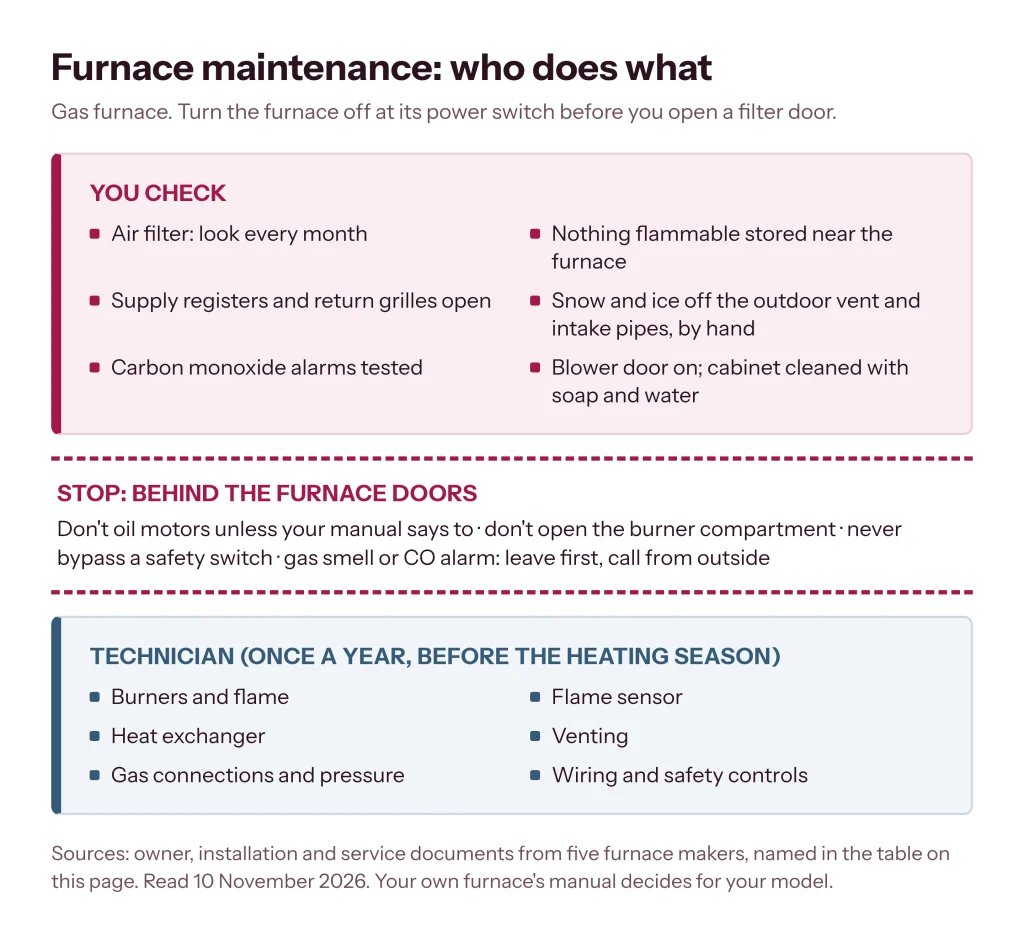
Furnace maintenance splits into two parts, and the five makers whose manuals we read draw the line in much the same place. Your part is the air filter, keeping the furnace area and the air grilles clear, keeping the outdoor vent and intake pipes free of snow and ice, and testing your carbon monoxide alarms. The technician’s part is everything behind the furnace doors: the burners, the flame sensor, the heat exchanger, the venting, the gas connections, the wiring and the safety controls, checked once a year before the heating season. Carrier’s installation and service instructions for its 59SC5 furnaces (59SC5A-11SI, Edition 10/18, p. 75) put it plainly: untrained people can do basic maintenance such as cleaning and replacing filters, and all other operations belong to trained service personnel.
This page, part of our maintenance and filters guides, sets out both lists from the makers’ own manuals, shows where the makers, ENERGY STAR and EPA disagree (filter intervals and oiling the motor), and explains what a yearly check should cover so you can tell a real inspection from a quick look.
Before anything else: gas smell, carbon monoxide, flooding
If you smell gas: leave the house now. Don’t switch lights or appliances on or off, don’t use a phone inside, and don’t try to find the leak. From outside or a neighbor’s home, call 911 or your gas utility’s emergency line. PHMSA, the federal pipeline safety regulator, also says not to strike a match, start an engine or use a garage door opener (PHMSA, natural gas emergencies). The makers’ manuals add: don’t try to light any appliance, call your gas supplier from a neighbor’s phone, and call the fire department if you can’t reach the supplier (Carrier owner’s manual 80GSFRN-B-03OM, cover; Lennox 507070-01, cover). On propane, Trane warns that the gas is heavier than air, that “odorant fade” can make it undetectable without a warning device, and that you shouldn’t rely on smell alone; it recommends fuel gas and CO detectors, and Lennox says an LP/propane leak detector should be installed in all propane installations (Trane 32-5083-1C-EN; Lennox 507070-01, p. 4).
If a carbon monoxide alarm sounds: get everyone outside into fresh air, call 911 or the fire department from outside, and don’t go back in until responders say it’s safe. CPSC says not to try to find the source first (CPSC, CO questions and answers). Headache, dizziness, weakness, nausea, chest pain or confusion that eases away from home can be carbon monoxide; CDC counts more than 400 US deaths a year from unintentional CO poisoning not linked to fires (CDC, CO basics, reviewed 26 October 2026). Don’t run the furnace again until a technician has checked it. More in carbon monoxide and your furnace.
A furnace that has been under water is not dried out and restarted. Carrier, Lennox and Trane all say not to use it; a qualified service agency inspects it and replaces every gas control, control part and electrical part that got wet, or the whole furnace if needed (Carrier 80GSFRN-B-03OM, p. 2; Lennox 507070-01, p. 6; Trane 32-5083-1C-EN).
General information, not professional advice. Your system’s maker, your manual and a qualified technician decide what’s safe for your equipment, and local codes decide what needs a permit or a licensed installer.
The owner line, maker by maker
Five makers’ documents, read for this page. Each speaks only for that maker’s furnaces, but they agree closely.
| Maker and document | What the owner does | What goes to a technician | How often |
|---|---|---|---|
| Carrier, 80% furnace owner’s manual 80GSFRN-B-03OM (Edition 08/22) | Filter; keep the area clear; look at the vent pipe and burner area with the power off | “All other operations” (p. 3) | Furnace and vent inspected annually (p. 2) |
| Goodman/Daikin, service manual RS6621301 (2023) | Filters: “the owner’s responsibility” | Flame sensor “qualified servicer only”; don’t remove internal covers or adjust anything | At least once a year, at the start of the heating season (p. 11) |
| Lennox, EL296DFE user’s manual 507070-01 (07/2018) | Filters; clear snow and ice from the plastic vent pipes; watch for warning signs | Maintenance by a licensed professional technician: “Do not attempt to service the unit in any way” (p. 5) | Annually, to meet the limited warranty (p. 3) |
| Trane, gas heating owner’s information 32-5083-1C-EN (2024) | Filters; clean the cabinet finish; keep storage away; keep vent terminals clear | Repairs and adjustments; do-it-yourself repairs on an in-warranty unit “may void your warranty” | Start of each heating season |
| Rheem, R96V installation instructions 92-24161-124-08 (no print date shown; supersedes -07) | Keep filters clean; keep grilles open; combustibles 3 feet away | Flue, vent, burners, flame sensor, condensate trap (pp. 109-110) | Annually, plus a flame check mid-season |
Your part: the owner checklist
Turn the furnace off at its power switch before you open a filter door or touch anything on the cabinet. Goodman warns that more than one power source may be present, and Carrier that there may be more than one electrical supply to the furnace (RS6621301, p. 11; Carrier 59SC5A-11SI, p. 75).
1. Check the filter every month
This is the one job every maker gives the owner, and the one that matters most. Goodman calls dirty filters “the most common cause of inadequate heating or cooling performance” (RS6621301, p. 11). Carrier says a dirty filter strains the furnace, heat exchanger and blower motor and can make the furnace overheat and shut itself down (80GSFRN-B-03OM, p. 5). How often to change it is where the sources differ:
| Source | What it says |
|---|---|
| ENERGY STAR | Inspect, clean or change air filters once a month |
| Carrier (80GSFRN-B-03OM, p. 5) | Check every 4 weeks and clean or replace if needed; factory-specified disposable media filters: check before each heating and cooling season, replace at least twice a year |
| Lennox (507070-01, p. 4) | Inspect monthly; clean or replace when needed |
| Trane (32-5083-1C-EN) | Disposable filters every month; twice a month when the system runs more |
| Goodman (RS6621301, p. 11) | Clean or replace every two months, or as required |
| EPA | Makers “typically recommend replacement every 60 to 90 days”; change more often if filters look heavily soiled |
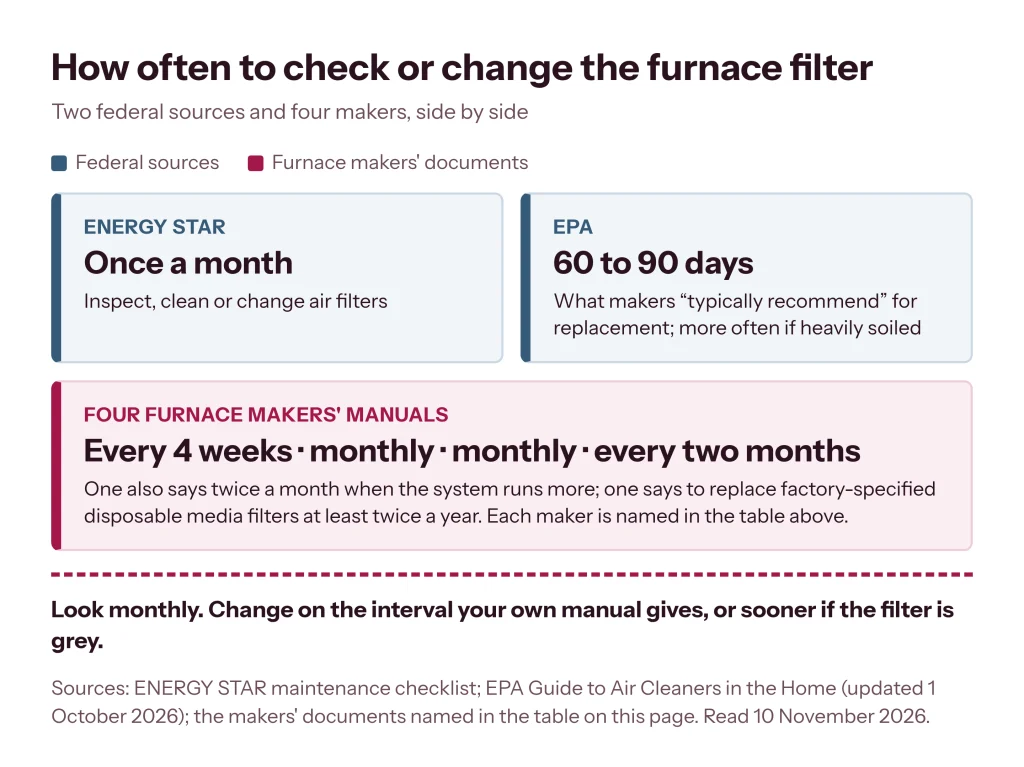
They fit together better than they look: look monthly, change on the interval your own manual gives or sooner if the filter is grey. Use the same size and type the installer fitted (Carrier, Trane, Goodman), with the airflow arrow pointing toward the blower. Never run the furnace without a filter: Carrier says dust and lint on internal parts cost efficiency and can damage the blower motor, and Goodman adds a fire risk (80GSFRN-B-03OM, p. 5; RS6621301, p. 11). A washable filter is rinsed in cold water against the direction of airflow and left to dry; a disposable media filter is never washed (Carrier, p. 6).
On filter ratings the sources split. EPA says most furnaces can take a MERV 13 filter without equipment problems “provided that the filter is replaced frequently”. Lennox says filters with higher filtration ratings than the installer’s “may restrict air flow” and can shorten blower motor life (507070-01, p. 5). Ask your technician what your blower and filter slot can take. Sizes, ratings and intervals in detail: how often to change a furnace filter.
2. Keep the furnace area clear
- Nothing flammable nearby. No gasoline, paint thinner, aerosol cans, rags, mops or paper stored on or near the furnace (Carrier 59SC5A-11SI, p. 76). Rheem’s list says to keep combustible articles 3 feet from the furnace and vent system (92-24161-124-08, p. 110).
- No household chemicals in the furnace room. Fumes from laundry products, bleach, cleaners, water softener salt, paints and adhesives can be drawn into the burners and corrode the heat exchanger and vent (Carrier 80GSFRN-B-03OM, p. 2; Trane 32-5083-1C-EN).
- Room to breathe. The furnace needs air for combustion. Don’t block its air openings or the openings into the room, don’t box it in behind solid doors or in an airtight room, don’t cover it, and keep insulation clear of it, since some insulation can burn (Carrier 80GSFRN-B-03OM, pp. 2 and 7).
3. Keep supply registers and return grilles open
Furniture, rugs and curtains over the registers and return grilles choke the airflow the furnace depends on (Carrier 80GSFRN-B-03OM, p. 2; Rheem, p. 110). Low airflow makes the furnace run hot, and the high limit switch, a safety switch that cuts the burners when the furnace overheats, starts cutting in. Trane says that if you suspect the furnace is cycling on its limit control, contact a qualified technician (32-5083-1C-EN).
4. Clear snow and ice from the vent pipes outside
High-efficiency (condensing) furnaces vent through plastic pipes in an outside wall or the roof, often two: one brings in combustion air, the other carries exhaust out. Lennox tells owners that after heavy snow, ice or freezing fog these pipes may be restricted, and to check the vent system and remove any snow or ice blocking the plastic intake or exhaust pipes (507070-01, pp. 3 and 6). Lennox and Trane both say the vent and intake terminals must not be obstructed “in any way during all seasons” (507070-01, p. 3; 32-5083-1C-EN). Clear them by hand from outside; don’t pull, twist or loosen the pipes. If a pipe is cracked, loose or disconnected, leave the furnace off and call: a blocked or broken vent can push combustion gases into the house.
5. Look at the vent pipe before the heating season
Carrier’s owner manual for its 80% furnaces asks owners to inspect the combustion area and vent before each heating season, with the electrical supply off, the outer access door removed and a flashlight: look for a sagging pipe, holes, a disconnected joint, rust, or signs of water leaking at joints and seams, and look at the burner area for dirt, rust, soot or scale. If you find any of these, Carrier says call for service, and if the vent has holes, is blocked or isn’t connected, “DO NOT OPERATE YOUR FURNACE” (80GSFRN-B-03OM, p. 7). Look, don’t fix, and put the door back before the power goes on. If your furnace isn’t a Carrier, check that your own owner’s manual gives this step before you take a door off.
On slope, the manuals we read describe the same direction in different words: the pipe rises as it runs away from the furnace. Carrier’s 80% owner’s manual says a horizontal vent pipe must slope upward away from the furnace (p. 7). Lennox’s manual for its EL296DFE condensing furnace says the vent pipe must slope upward away from the furnace, and its technician checklist says the exhaust pipe is sloped toward the furnace (507070-01, pp. 5-6). How much slope is set in the installation instructions for your model, so if a pipe sags, dips or seems to run the wrong way, leave it alone and ask the technician.
6. Test your carbon monoxide alarms
CPSC recommends battery or battery-backup CO alarms meeting UL 2034 on every level of the home and outside sleeping areas, ideally interconnected so that when one sounds they all sound. It also notes that the test button checks the alarm’s circuitry, not the accuracy of the sensor, and that alarms have a replacement age in their instructions (CPSC). Lennox puts checking CO detectors and replacing batteries on its own annual list for the ML180 furnace (508547-01, 12/2025, p. 41). Whether your home must have them is set by your state or city, not by a national rule.
7. Keep the doors on and the cabinet clean
The blower door must be firmly in place whenever the furnace runs. Many furnaces have a door switch that shuts them down when it’s open, and Trane warns that the unit must not be altered to run with the door removed, since doors that are off or ajar can let dangerous fumes escape (32-5083-1C-EN; Lennox 507070-01, p. 3). Trane’s owner list also includes cleaning the cabinet’s enamel finish with soap and water, never with lacquer thinner or combustible cleaning fluids.
8. If you’re away in winter
Furnaces shut themselves off when a safety device trips, and an empty house can freeze. Carrier says to have the furnace checked periodically if it’s left unattended for a long time (80GSFRN-B-03OM, p. 2); Lennox says the same, and if that isn’t possible, to shut off the water supply and drain the pipes (507070-01, p. 2). Lennox also says not to set the thermostat below 60°F in heating mode, because fewer heating cycles can damage the unit in a way its warranty doesn’t cover (507070-01, p. 4).
What not to do, and where the advice conflicts
- Don’t oil the motors unless your manual says to. Here the general advice and the makers part company. ENERGY STAR’s checklist says a check-up should “lubricate all moving parts”, and the Department of Energy’s furnace page, now offline and read in an Internet Archive copy captured 31 May 2026, lists “clean and oil the blower” (DOE Energy Saver, archived). But Carrier, Goodman and Rheem say the blower and inducer motors in the furnaces we read are permanently lubricated and need no oil, Lennox says the same of its blower motors, and Rheem says adding lubricant “can reduce the motor life and void the warranty” (Rheem, p. 109; Carrier 59SC5A-11SI, p. 77; RS6621301, p. 11; Lennox 508547-01, p. 41). Carrier says its pre-lubricated motors are the ones with no oil ports. An older motor with oil ports is a question for the technician.
- Don’t open the burner compartment to clean or adjust. Goodman: “do not remove any internal compartment covers or attempt any adjustment” (RS6621301, p. 12). Lennox: “Do not attempt to service the unit in any way” (507070-01, p. 5). In Carrier’s service procedure for the burners and flame sensor, and in Lennox’s for the burners, cleaning starts with disconnecting the gas supply pipe and taking the burner assembly out, and Carrier says these steps must be performed by a qualified service technician (Lennox 508547-01, p. 42; Carrier 59SC5A-11SI, pp. 78-79). If you’re weighing it anyway, read what the flame sensor does and what Carrier’s procedure involves first.
- Never bypass, jumper or disable a safety switch: pressure, limit or rollout switch, flame sensor, door switch, or the refrigerant leak sensor on newer systems. Lennox: “Disabling the refrigerant detection functionality on A2L system is prohibited by safety codes” (508547-01, p. 1).
- Don’t light the burners by hand. Furnaces with hot surface or electronic ignition light themselves; Carrier, Lennox and Trane all say never to light them with a match or flame (80GSFRN-B-03OM, p. 3; 507070-01, p. 4; 32-5083-1C-EN).
What the yearly check covers
ENERGY STAR suggests having the heating system checked in the fall, before contractors get busy, and says a heating check should include the gas connections, gas pressure, burner combustion and the heat exchanger. CDC says to have your heating system and other gas, oil or coal burning appliances serviced by a qualified technician every year (same CDC page), and the US Fire Administration says to have heating equipment cleaned and inspected each year by a professional (USFA, heating fire safety). The makers’ lists are longer. Here is what they put in the yearly check, combined, with the terms explained:
| Item | What it is and why it’s checked | Listed by |
|---|---|---|
| Vent and intake pipes, chimney connector | In place, sloped right, no holes, corrosion, blockage or loose joints; outside terminations clear. A leaking vent can put combustion gases in the house | Lennox, Carrier, Goodman, Rheem, Trane |
| Heat exchanger | The metal chamber that keeps the flame and exhaust separate from the air you breathe. Checked for cracks, corrosion and buildup; Lennox asks for the AHRI inspection procedure; Rheem says a leaking heat exchanger or vent pipe “must be replaced” | Lennox, Carrier, Goodman, Rheem, ENERGY STAR |
| Burners and flame | Clean burners and a steady blue flame; buildup can cause delayed ignition, which Carrier says comes with an “alarmingly loud sound”. Rheem also recommends a flame check halfway through the season | All five makers |
| Flame sensor | A metal rod that proves the burners lit; if it can’t sense flame, the furnace shuts the gas off. Cleaned, with the flame current measured before and after (Lennox) or cleaned with fine steel wool or a scouring pad (Rheem) | Lennox, Rheem, Goodman |
| Ignition and safety controls | Igniter, gas valve, flame sensor, limit switches and the other safety controls checked for correct operation. Lennox says limits are tested by restricting airflow, not by disconnecting the blower | Lennox, Carrier |
| Gas piping and pressure | Gas connections leak-checked; inlet and manifold gas pressure measured and the firing rate checked | Lennox, Carrier, ENERGY STAR |
| Combustion analysis | An instrument reading of the exhaust to confirm the gas is burning completely | Lennox |
| Combustion air inducer | The small fan that pulls exhaust through the furnace; inspected and cleaned | Lennox, Carrier |
| Blower | Blower wheel, housing and motor checked and cleaned; Carrier’s 80% owner’s checklist says twice a year and its 59SC5 instructions annually, Lennox “if necessary” | Carrier, Lennox, Goodman |
| Wiring and electrical | Loose or corroded connections, voltage, motor current | Lennox, Carrier, Goodman, ENERGY STAR |
| Airflow and temperature rise | Total static pressure, airflow settings, and the temperature rise across the furnace within the label’s range | Lennox |
| Ducts and return connection | Return duct sealed to the furnace; supply and return leaks sealed | Lennox, Carrier |
| Condensate trap, drain and hoses (condensing furnaces) | Trap and drain cleaned and the trap refilled with water; pressure switch hoses checked for cracks and blockage; neutralizer replaced if fitted (Rheem). A blocked trap can back water into the heat exchanger and trip safety switches | Lennox, Rheem, Goodman |
| Refrigerant leak sensor (newer A2L cooling systems) | On furnaces paired with an R-454B or R-32 air conditioner, the leak sensor and its wiring | Lennox, Goodman |
| CO alarms | Operation verified, batteries replaced | Lennox |
The heat exchanger and the CO check are the safety core of the visit. DOE’s archived furnace page explains why: a leaking furnace heat exchanger mixes combustion gases with house air, “an important safety reason to have them inspected”, and it lists a carbon monoxide test among a professional’s tasks. Only a technician can confirm a crack; what they look for is in cracked heat exchanger: signs and what a technician checks. If the same technician services your air conditioner, the cooling side has its own list: see AC maintenance: the owner’s part and the tune-up checklist.
Timing, the warranty and your records
- When: the start of the heating season is the makers’ answer (Goodman, Lennox, Trane); ENERGY STAR suggests fall for heating and spring for cooling, and planning them around the clock changes.
- Warranty: Lennox makes the yearly inspection a warranty condition. Its manuals say that to comply with the Lennox Limited Warranty the system should be checked at the beginning of each heating season by a licensed professional technician, and that “to fulfill the terms of the limited warranty” a technician must inspect the furnace and its vent system annually (508547-01, p. 41; 507070-01, p. 3). Trane says do-it-yourself repairs on an in-warranty unit may void the warranty. Other makers’ warranty terms weren’t part of the documents we read; your own warranty certificate decides.
- Records: keep each visit’s invoice with the date, what was checked and any readings. Carrier and Lennox both leave space in the owner’s manual for the model and serial number from the rating plate; write them there, with the installation date.
Goodman, Lennox and Trane tell owners not to service the unit, and Trane says do-it-yourself repairs on an in-warranty unit may void the warranty. If you’re not comfortable with a task, or a code comes back, stop and call a technician.
When maintenance turns into a repair call
Stop, turn the furnace off and call a technician (or, for gas and CO, leave first and call from outside) when you notice any of these:
- A gas smell, or a CO alarm going off: see the box at the top.
- Dirt, rust, soot or scale at the burners, or a vent pipe with holes, a sag or a disconnection. Carrier: don’t operate the furnace (80GSFRN-B-03OM, p. 7).
- A loud noise when the burners light (Carrier, p. 7), or new and repeated noises, unusual smells, visibly burnt parts or heavy condensation on windows (Lennox 507070-01, p. 6).
- Headaches, nausea, tiredness or dizziness that ease when you’re away from home. Lennox says this is often mistaken for flu and can be carbon monoxide (507070-01, p. 6).
- A furnace that keeps shutting off on its own, or a flashing light or code on the control board. Makers differ on whether owners may reset a tripped safety switch at all: Carrier’s owner manual allows one reset of its manual-reset limit switches and says to call if one trips again (p. 7); Trane says the cause of a rollout or pressure switch shutdown must be investigated by a qualified service technician, and to contact one if you suspect the furnace is cycling on its limit control (32-5083-1C-EN). Look up the code in our furnace error code lookup, which gives each maker’s meaning and who acts.
Does the 2028 furnace rule change any of this?
No. The current federal minimum for a new non-weatherized gas furnace is 80% AFUE (annual fuel utilization efficiency: the share of the gas’s energy that becomes heat over a year). A 95% minimum is in the regulation for furnaces manufactured from 18 December 2028 (10 CFR 430.32(e)(1)). On the books for furnaces made from 18 December 2028; under legal review; may change (checked 10 November 2026): on 8 June 2026 the Supreme Court vacated the appeals court judgment that had upheld the rule and sent the case back (No. 25-879), and DOE has published a petition to delay the dates (91 FR 22477, 27 April 2026) without deciding it. The rule governs how furnaces are made, not the one already in your basement, and maintenance doesn’t change. More in AFUE and the 2028 furnace rule.
Next step
- Today: pull the filter and look at it, check that nothing is stored against the furnace, and press the test button on each CO alarm.
- Find your manual: the model number on the rating plate (on the blower door of the Carrier furnaces in its owner’s manual; on the blower deck on the Lennox EL296DFE) gets you the owner’s manual on the maker’s own site, with your furnace’s filter interval and warranty terms.
- Before the technician comes, write down the model and serial number, the installation date if you know it, any codes or flashes the board has shown, and anything odd you’ve heard or smelled, with dates.
- Ask the technician: did you inspect the heat exchanger, and how? Did you do a combustion analysis and a CO test, and what were the readings? What is the flame sensor reading? What filter rating can my system take? Is anything you found needed for my warranty?
- What can’t wait: a gas smell, a CO alarm, a burning smell from wiring, or a furnace that has been under water.
Sources checked on 10 November 2026.
Sources
- Carrier, Non-Condensing 80% AFUE Gas Furnace Owner's Manual, Catalog No. 80GSFRN-B-03OM (Edition 08/22)
- Carrier, 59SC5 Condensing Gas Furnace Installation, Start-up, Operating and Service and Maintenance Instructions, Catalog No. 59SC5A-11SI (Edition 10/18)
- Goodman/Daikin, Service and Troubleshooting, 80% Single Stage Gas Furnaces, RS6621301 (2023)
- Lennox, EL296DFE Gas Furnace User's Information Manual, 507070-01 (07/2018)
- Lennox, ML180UHVK Merit Series Gas Furnace Installation Instructions, 508547-01 (12/2025)
- Trane, Gas Heating Systems Owner's Information, Doc. 32-5083-1C-EN (2024)
- Rheem, (-)96V and (-)(-)96MDV Gas Furnace Installation Instructions, 92-24161-124-08 (no print date shown; supersedes 92-24161-124-07)
- ENERGY STAR, Maintenance Checklist
- EPA, Guide to Air Cleaners in the Home (updated 1 October 2026)
- CDC, Carbon Monoxide Poisoning Basics (reviewed 26 October 2026)
- CPSC, Carbon Monoxide Questions and Answers
- PHMSA, Recognizing and Responding to Natural Gas Emergencies
- US Fire Administration, Heating fire safety
- DOE Energy Saver, Furnaces and Boilers (Internet Archive copy captured 31 May 2026; live page returns 404)
- eCFR, 10 CFR 430.32 Energy and water conservation standards (current to 6 November 2026)
- Supreme Court docket No. 25-879
- Federal Register, 91 FR 22477, Notification of Petition for Rulemaking (27 April 2026)