When a gas furnace won’t turn on, the cause is usually one of a short list the makers print for owners: the thermostat isn’t set to HEAT above room temperature, the furnace switch or breaker is off, the blower door isn’t fully closed (a safety switch cuts the power when it’s open), the filter is so dirty that a limit switch shut the burners off, a gas valve is closed, snow is blocking the plastic vent pipes outside, or the control has locked itself out after failed starts. Check those in order, read the code on the control board, and reset a lockout once the way your furnace’s own manual says. If it locks out again, the code comes back, a breaker trips again or you smell gas, stop and call a technician.
Part of our furnace problems guide. Every check below comes from a maker’s own manual, named with its document number and date, or from a federal agency. Makers differ, and so do boards from the same maker: the labels and manual on your own furnace win wherever they differ from what we write here.
Before you touch the furnace
- If you smell gas: leave the house now. Don’t switch lights or appliances on or off, don’t use a phone inside, and don’t try to find the leak. From outside or a neighbor’s home, call 911 or your gas utility’s emergency line. The federal pipeline safety agency, PHMSA, adds: don’t start an engine, strike a match or work a garage door opener. Stay out until the responders say it’s safe to go back, and don’t try to relight anything.
- If a carbon monoxide alarm sounds: get everyone outside into fresh air, call 911 or the fire department from outside, and don’t go back in until responders say it’s safe. CPSC says not to look for the source, and if an appliance turns out to be the source, not to run it again until trained personnel have serviced it. Headache, dizziness, weakness, upset stomach, vomiting, chest pain or confusion can be carbon monoxide (CDC), and Lennox’s EL296DFE manual adds that flu-like symptoms that ease while you’re away from home point the same way (507070-01, p. 6). More on alarms and symptoms: carbon monoxide and your furnace.
- Propane: Trane’s owner guide warns that propane is heavier than air and that “odorant fade” can make a leak hard to smell, so don’t rely on smell alone; a gas detector helps. Lennox’s EL296DFE manual says not to try to bleed air out of propane lines: call your gas provider.
- Flooded furnace: if any part of the furnace has been under water, don’t turn it on. Carrier, Lennox and Trane all call a flood-damaged furnace extremely dangerous and say to have a qualified service agency or technician inspect it and replace the gas controls, control parts and electrical parts that got wet, or the furnace if needed.
- Shutting it down: thermostat to its lowest setting, close the manual gas valve on the pipe to the furnace, then turn off the power (Carrier owner’s manual 80GSFRN-B-03OM, p. 5). If the burners won’t shut off or the furnace overheats, Carrier, Lennox and Trane say to close the manual gas valve before you turn off the power.
General information, not professional advice. Your system’s maker, your manual and a qualified technician decide what’s safe for your equipment, and local codes decide what needs a permit or a licensed installer.
The owner’s line for a furnace that won’t start
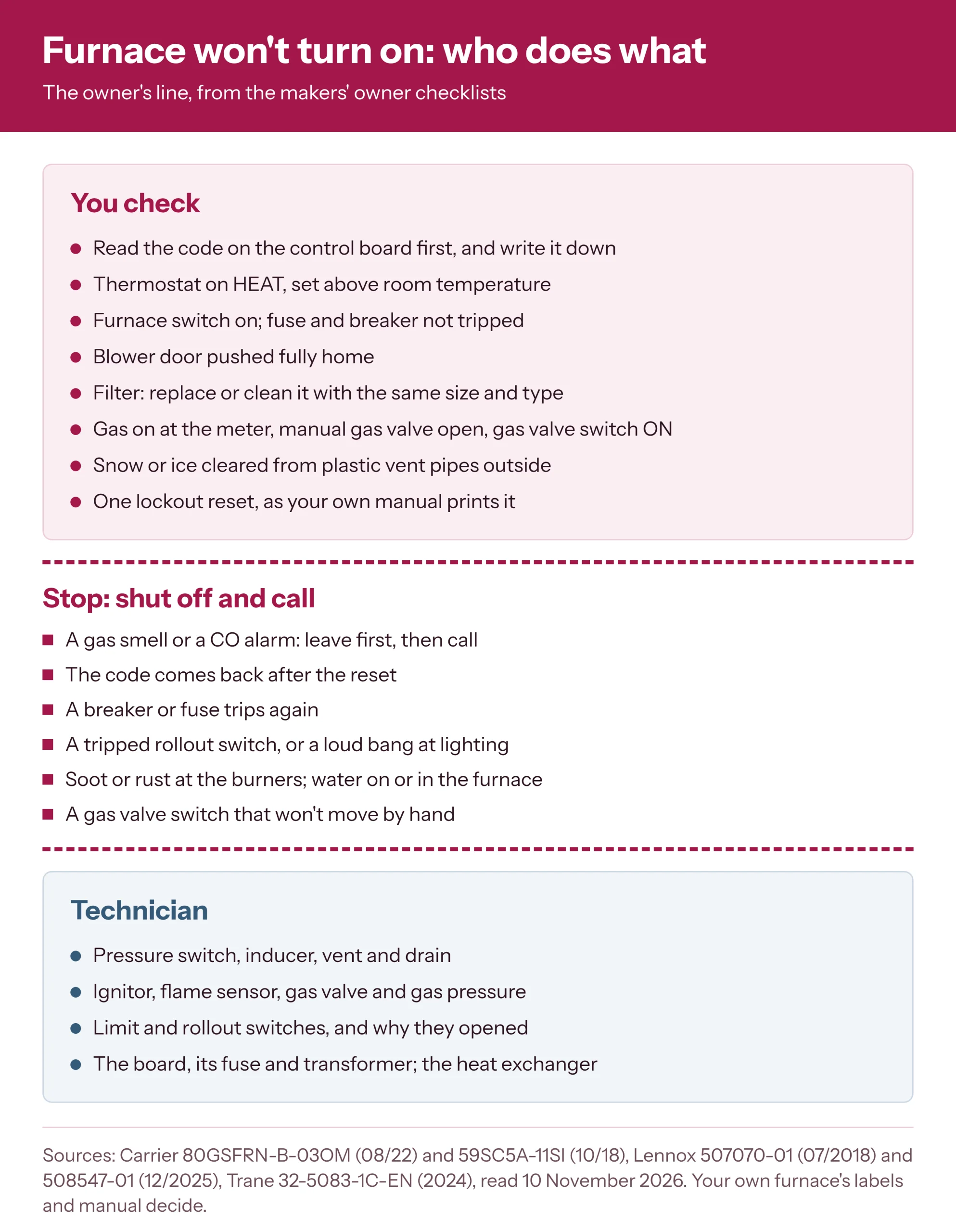
- You check: thermostat mode and setting; the furnace switch, fuse and breaker; the blower door seated; the filter; the gas meter, the manual gas valve and the switch on the gas valve; snow or ice on plastic vent pipes outside; the code on the control board; one lockout reset as your manual prints it.
- Stop: a gas smell, a CO alarm, a code that comes back after the reset, a breaker or fuse that trips again, a tripped rollout switch, a loud bang at lighting, soot or rust at the burners, water on or in the furnace, a gas valve switch that won’t move by hand.
- Technician: the pressure switch, inducer, vent and drain; the ignitor; the flame sensor; the gas valve and gas pressure; the limit and rollout switches and why they opened; the board, its fuse and transformer; and the heat exchanger.
How a furnace starts, and where yours stops
A modern gas furnace doesn’t just light. When the thermostat calls for heat, the control runs a fixed sequence and checks a safety device at each step. If any check fails, it stops there. Carrier’s owner’s manual for its 80% furnaces (80GSFRN-B-03OM, edition 08/22, p. 5) describes it: the inducer (a small fan motor that pulls combustion gases out through the vent) starts, the hot surface ignitor (a ceramic element that glows orange) heats up, after about 17 seconds the gas valve opens and the burners light, and after another 25 to 45 seconds the main blower starts pushing warm air into the house. Lennox’s ML180UHVK instructions (508547-01, 12/2025, p. 38) give a 15-second prepurge, a 20-second ignitor warm-up, then a 4-second trial for ignition, with a pressure switch proving the inducer is moving air and a flame sensor (a metal rod in the flame) proving the burners lit.
So the most useful thing you can do before anything else is raise the thermostat a few degrees, stand near the furnace with the doors on, and notice how far it gets. Listen for the inducer’s hum, look through any window or slots in the door for the ignitor’s glow and the flame, and wait a full two minutes.
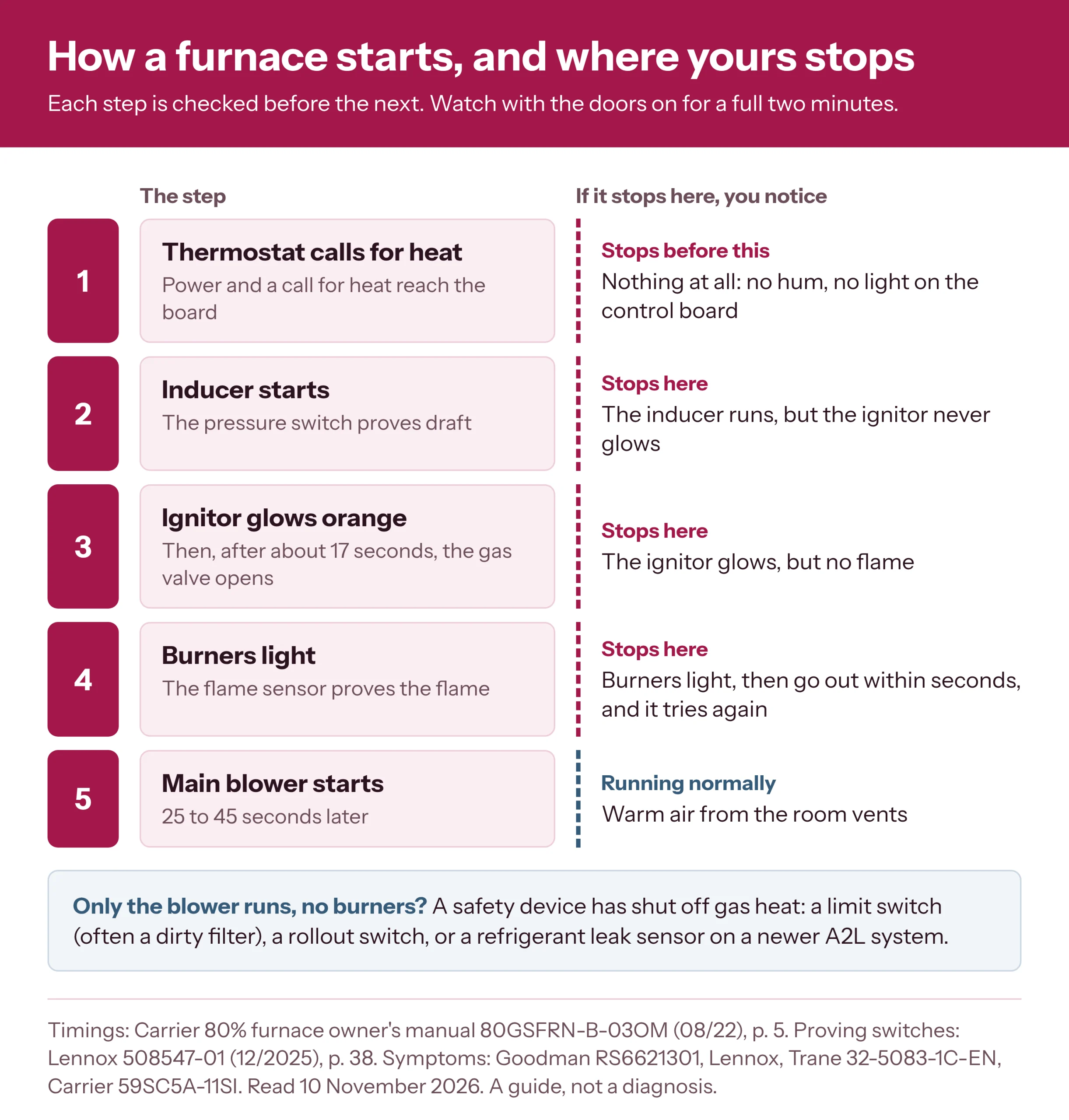
| What you notice | Where it stopped | Causes the makers list | Your part |
|---|---|---|---|
| Nothing at all: no hum, no light on the control board | No power, or no call for heat | Thermostat setting or wiring, furnace switch, breaker, blower door switch, blown board fuse, transformer (Goodman RS6621301 “No Heat” chart, p. 36) | Thermostat, switch, breaker, blower door |
| The inducer runs, but the ignitor never glows | The pressure switch didn’t prove draft | Blocked vent or intake, blocked condensate drain on a high-efficiency furnace, inducer or hose problems (Lennox 508547-01 p. 38; Trane 32-5083-1C-EN) | Clear snow from plastic vent pipes outside |
| The ignitor glows, but no flame | Gas didn’t reach the burners | Gas valve switch or manual shut-off closed, gas off at the meter, gas valve or ignitor fault (Carrier 59SC5A-11SI, code 34) | Gas valves on, gas on at the meter |
| Burners light, then go out within seconds, and it tries again | The flame sensor didn’t prove the flame | Coated or failed flame sensor, poor ground, gas supply (Carrier code 34; Goodman code E E 6; Lennox E270) | None beyond the reset; see the technician list |
| Only the blower runs, no burners | A safety device has shut off gas heat | Limit switch open (often a dirty filter), rollout switch open, or a refrigerant leak sensor on a newer A2L system (Goodman RS6621301 pp. 20 and 35; Carrier 59SC5A-11SI Fig. 70, code 33; Lennox 508547-01 p. 38) | Filter; then stop |
The table is a guide to the conversation, not a diagnosis: the code on your board is more exact, and only a technician with instruments can confirm which part failed.
You check: the makers’ owner steps, in order
Carrier (80GSFRN-B-03OM, p. 7, “Before You Request a Service Call”), Lennox (EL296DFE user’s manual 507070-01, 07/2018, p. 5; ML180UHVK instructions 508547-01, p. 38, “Failure To Operate”) and Trane (owner’s information 32-5083-1C-EN, 2024, “Before you call for service”) each print an owner checklist. They overlap almost entirely. Here it is in a sensible order.
One thing first: if your furnace has a status light or display, read it now (step 7), before you switch off the power or open a door. The blower door switch cuts power to the board, and on Carrier’s 59SC5 a brief power interruption ends an ignition lockout (59SC5A-11SI, edition 10/18, p. 83), so the code flashing now may be gone once you start checking. (That control does keep its most recent fault code in memory for a technician to retrieve, p. 75.)
1. The thermostat
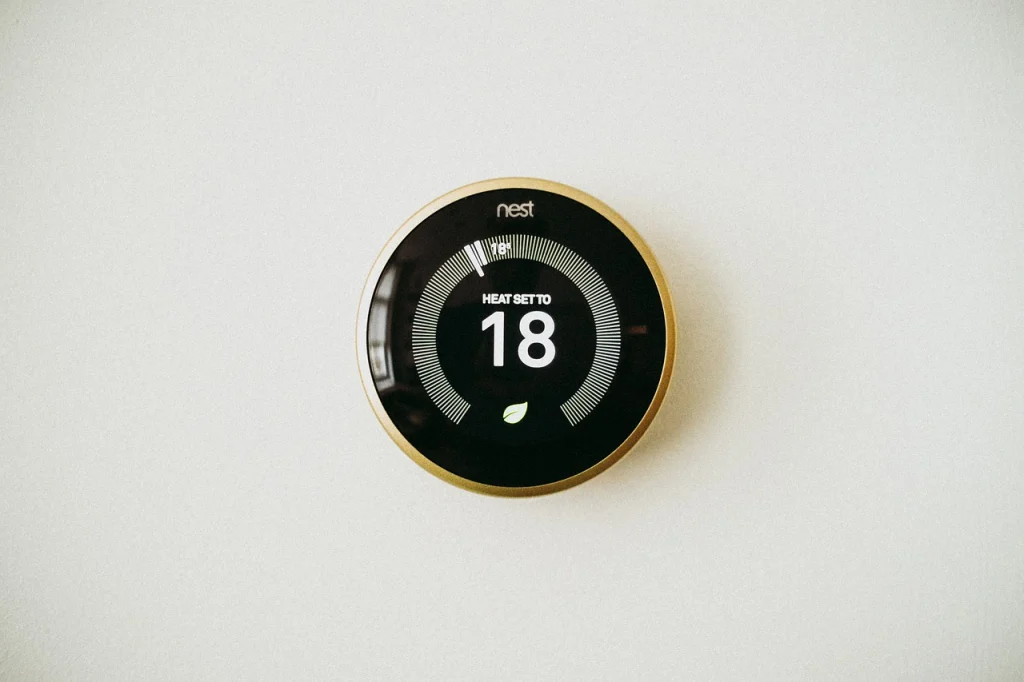
Is it set to HEAT, and is the setting above the room temperature (Carrier p. 7; Trane lists a thermostat set incorrectly first)? Raise it a few degrees so the call for heat is unmistakable. Lennox’s EL296DFE manual (p. 4) adds a caution: don’t set the thermostat below 60°F in heating, because that reduces the number of heating cycles and can cause damage the warranty doesn’t cover. If the thermostat screen is blank or it won’t take a setting, start with our thermostat check.
2. The furnace switch, fuse and breaker
Furnaces have their own power switch, usually on or near the cabinet (Carrier calls it the electrical power supply switch, Lennox the disconnect switch). Make sure it’s on, then check the breaker or fuse for the furnace’s circuit (Carrier, Lennox, Trane). Reset a tripped breaker once. If it trips again, leave it off and call: a breaker that trips repeatedly points to a fault a technician needs to find. Carrier’s service instructions also note that there may be more than one power supply to a furnace (59SC5A-11SI, p. 75).
3. The blower door
The lower door on most furnaces presses a door switch. When the door is off or ajar, the switch cuts power to the control, the blower and the gas valve. Carrier’s service instructions say power reaches the control, transformer, inducer, blower, ignitor and gas valve only through that switch (59SC5A-11SI, p. 83), and Trane’s owner table lists “blower door removed or ajar” as a cause of no heat, fixed by closing the door securely. After a filter change, push the door fully home and tighten any thumbscrew. Never tape, wedge or jumper the switch: Trane’s guide says the furnace “must not be altered to allow operation with the blower door removed”, because running with doors off can let dangerous fumes escape.
4. The filter
A clogged filter starves the furnace of air. The heat exchanger gets too hot, and the limit switch (a temperature safety switch) shuts the burners off. Lennox’s ML180UHVK checklist says a dirty or plugged filter will make the limit control shut the unit off (508547-01, p. 38). Carrier’s owner’s manual says a dirty filter can make the furnace “overheat and automatically shut down” (p. 5). Turn the power off, pull the filter, and replace or clean it with the same size and type. Carrier, Goodman and Trane all say never run the furnace without one. Intervals differ by maker; we compare them in how often to change a furnace filter. While you’re there, make sure supply and return grilles in the rooms aren’t closed or blocked by furniture (Carrier p. 7, Trane).
5. The gas supply
- Is gas on at the meter? (Lennox 507070-01 p. 5.) If other gas appliances also stopped, call your gas utility. Trane’s table says “Main gas line turned off: have gas company check.”
- Is the manual shut-off valve open? This is the valve on the gas pipe leading to the furnace. Carrier’s owner’s manual: open when the lever points the same way the pipe runs, closed when it’s at a right angle (p. 7).
- Is the switch on the furnace’s gas valve ON? Carrier says to turn off the power and remove the access door before you look (p. 7). Use only your hand: Lennox says never use tools, and if the switch won’t move by hand, don’t try to repair it, because force “may result in a fire or explosion” (507070-01, p. 4).
If you find a valve closed, Carrier’s manual adds one sentence worth reading twice: “make sure the gas has not been shut off for safety reasons” (p. 7). A technician or the utility may have closed it on purpose. Then restart by the lighting instructions on the label inside your furnace door, which include waiting 5 minutes with the gas valve OFF and smelling for gas, including near the floor, before you turn it back on (Carrier pp. 3-4; Lennox 507070-01 p. 4; Trane). If you smell gas at that point, stop and follow the gas box above.
Older furnaces with a standing pilot (a small flame that burns all the time) are lit by hand by the label on that furnace; newer ones with a hot surface ignitor must never be lit by hand (Carrier p. 3; Lennox; Trane). Lighting a pilot gets its own page.
6. Snow and ice on the vent pipes outside
High-efficiency furnaces often vent through plastic pipes out a side wall or the roof. Lennox’s EL296DFE user’s manual tells owners that after heavy snow, ice or “frozen fog” the vent pipes may become restricted, and to check them and remove any snow or ice blocking the plastic intake or exhaust pipes (507070-01, pp. 3 and 6). Trane’s table says to make sure vent terminals aren’t blocked. A blocked pipe stops the pressure switch from proving, and the furnace won’t light. Clear the snow and ice away from the pipe ends from outside, and don’t push anything into the pipes. If a pipe is cracked, disconnected or sagging, don’t run the furnace and call: Carrier’s owner’s manual says a disconnected or obstructed vent can let toxic fumes into the home (p. 7).
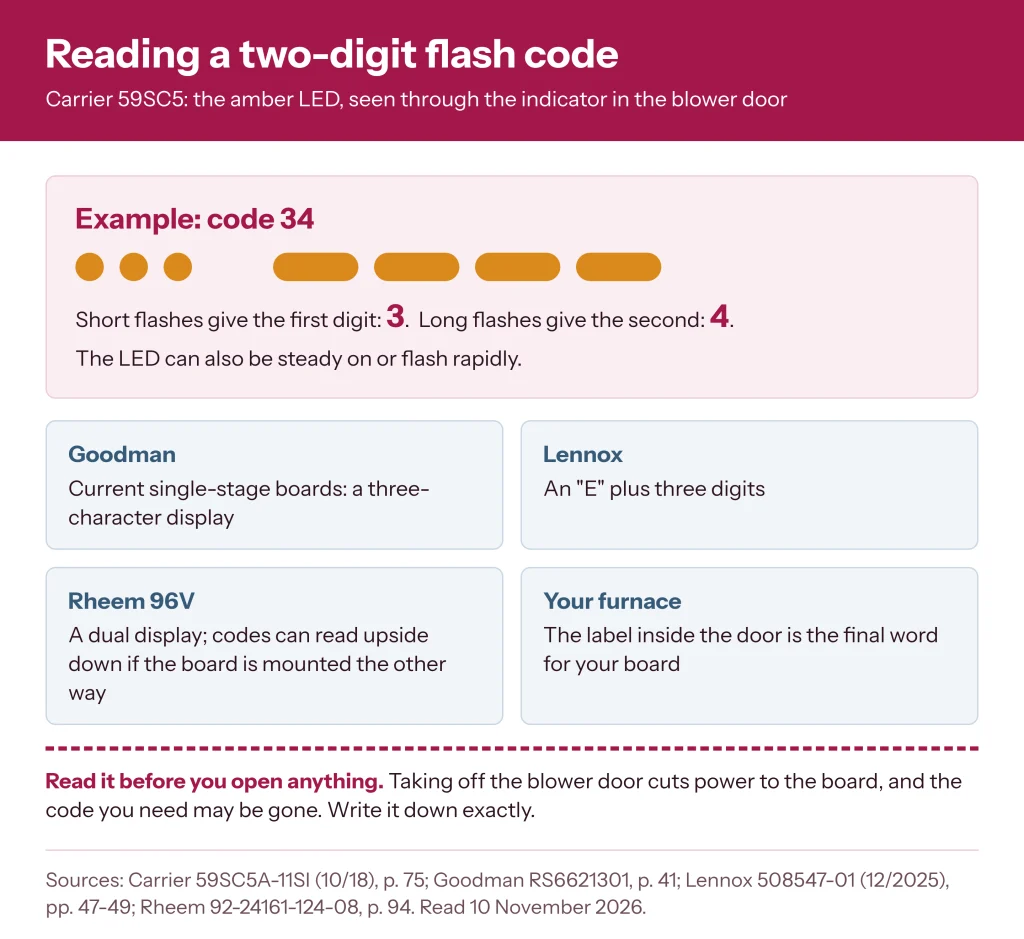
7. Read the code before you open anything
Many furnaces have a control board that reports what went wrong, as a blinking light or a short code on a display. Read it before you take the blower door off, because on many furnaces opening that door cuts power to the board. Carrier’s 59SC5 instructions have you watch the amber LED through the indicator in the blower door: steady on, rapid flashing, or a two-digit code made of short flashes (first digit) and long flashes (second) (59SC5A-11SI, p. 75). Goodman’s current single-stage boards use a three-character display (RS6621301, November 2023, p. 41), Lennox an “E” plus three digits (508547-01, pp. 47-49), and Rheem’s 96V a dual seven-segment display; Rheem says to check the display’s orientation first, because otherwise the codes may read upside down (92-24161-124-08, p. 94).
Write the code down exactly, then look it up with our furnace error code lookup, which gives each maker’s meaning and links the maker’s document. The label inside your furnace door is the final word for your board.
8. One lockout reset, the way your manual prints it
If the burners fail to light after several tries, the control stops trying and goes into lockout. Many lockouts also clear on their own after a set time. The makers say different things about whether the owner should reset one:
| Maker and document | Tries before lockout | What the document says about resetting |
|---|---|---|
| Trane, Gas Heating Systems Owner’s Information, 32-5083-1C-EN (2024) | Not stated | Owner table: for a lockout, “Turn power on-off-on-off twice in 30 seconds.” |
| Lennox, ML180UHVK instructions, 508547-01 (12/2025), p. 38 (a manual Lennox says must be left with the homeowner) | First try plus four more | Waits 60 minutes, then starts over by itself. Moving the thermostat from HEAT to OFF and back to HEAT ends the wait. “If the unit locks out again, call the service technician to inspect the unit for blockages.” |
| Carrier, 80% furnace owner’s manual, 80GSFRN-B-03OM (08/22), p. 5 | First try plus three more | “If lockout occurs or the blower does not come on, shut down your furnace and call your dealer for service.” (Carrier’s service instructions, 59SC5A-11SI p. 83, say the 59SC5 control resets itself after 3 hours, or when its power is briefly interrupted.) |
| Rheem, 96V installation instructions, 92-24161-124-08, p. 121 | Four ignition trials | A one-hour lockout resets itself. Any lockout clears when the fault is fixed and power is cycled off and on. Some faults cause a “hard” lockout that cycling the thermostat won’t clear. |
So: follow the step printed for your own furnace, once. Trane’s power cycle means using the furnace switch or breaker, not pulling wires. If it lights and runs a full cycle, note the code and the time, because the cause is still there and it will probably return. If it locks out again, stop. Repeated resets just repeat failed ignition, and the cause is still there.
Stop here: when to leave it for a technician
- A gas smell or a CO alarm, at any point: follow the boxes at the top.
- A code that means flame when there shouldn’t be one. Carrier 22, Goodman E E 4, Lennox E241 and E275, Rheem 14 all report flame sensed with the gas valve supposed to be closed. Lennox’s action for E241 starts “Shut off gas”; Rheem calls its code 14 “extremely critical”. Close the manual gas valve and call.
- The code comes back after one reset, or the breaker or fuse trips again.
- A tripped rollout switch. A rollout switch opens when flame comes out of the burner area instead of going into the heat exchanger. Makers differ here. Carrier’s owner’s manual for its 80% furnaces calls them the manual reset limit switches on the ends of the burner enclosure, says they trip after a high-temperature condition from too little combustion air, and tells owners to push the button and call for service if a switch trips a second time (p. 7). Lennox says to call the service technician for an inspection if its flame rollout switches are tripped (508547-01, p. 38), Trane says the cause “must be investigated by a qualified service technician”, and Rheem calls a rollout trip a very serious problem that must be repaired before the furnace runs again (92-24161-124-08, fault 33, p. 116). Because flame in the wrong place is also a fire and carbon monoxide sign, we’d have it investigated before any reset, and never reset it twice.
- A limit switch that keeps tripping even with a clean filter and open grilles. Trane says if you suspect the furnace is cycling on its limit, “immediately contact a qualified service technician”.
- A loud bang when the burners light: Carrier says shut the furnace down and call your servicing dealer. Dirt, rust, soot or scale at the burners or vent: Carrier says call your dealer and “Do not operate your furnace” (p. 7).
- Water on or in the furnace, or a furnace that has been under water.
- A gas valve switch that won’t move by hand.
Fan runs but no heat? Three causes worth knowing
A refrigerant leak sensor (newer systems). Many newer air conditioners use R-454B or R-32, refrigerants that EPA’s SNAP list classes as A2L (lower flammability). Some furnaces paired with them, including current Goodman and Lennox models, read a leak sensor at the indoor coil. On a leak, Goodman’s board shuts off gas heat and runs only the blower, and resumes “once a leak is not detected and the 5 minute delay period is over” (RS6621301, p. 35). Lennox shows E150, “Refrigerant leak detected”, which can’t be cleared while the sensor reports a leak (508547-01, p. 48). If your furnace is new, the blower won’t stop and the burners won’t light, this may be why. Call a technician: repairing the leak means opening the refrigerant circuit, which federal rules reserve for EPA-certified technicians (40 CFR 82.161). Never unplug or bypass the sensor; Lennox says disabling refrigerant detection “is prohibited by safety codes” (508547-01, p. 1).
An open safety switch. On Goodman’s 80% furnaces, an open rollout switch makes the blower run continuously (RS6621301, p. 20). On Carrier’s 59SC5, an open limit or rollout switch shows code 33 and the blower runs for at least 4 minutes or until the switch closes again (59SC5A-11SI, Fig. 70). See the Stop list.
Just after a power cut. If power drops during a call for heat, Carrier’s 59SC5 control runs the blower alone for 90 seconds when it comes back, flashing code 12, before it responds to the thermostat normally (59SC5A-11SI, p. 83). Give it two minutes before you decide something is wrong.
High-efficiency furnaces: the drain can stop the heat
A condensing furnace (the high-efficiency kind with plastic vent pipes) makes water as it runs and drains it through a trap and a hose, sometimes to a small pump. If that drain blocks or freezes, the furnace shuts itself off. Rheem’s 96V instructions say that depending on how the drain was installed, a blocked drain either shuts the furnace off with “no heat” or spills water while it keeps running, and that a trap exposed to freezing temperatures will freeze and shut the furnace down (92-24161-124-08, p. 67). Carrier warns that a plugged drain or a failed condensate pump may shut the furnace down (59SC5A-11SI, p. 16). Trane’s owner table lists a restricted condensate drain under “No heat, vent motor is running”, with the remedy “Call servicer”.
Your part: look for water around the furnace, a full condensate pump, or a drain line running through a cold space. Turn the furnace off at the switch if water is near electrical parts. Clearing the trap, the collector box and the pressure switch hoses is in the makers’ technician sections, so it stays with the technician; our pressure switch page explains the parts.
Technician: what they’ll check
Carrier’s service instructions and owner’s manual both say that untrained people can do basic maintenance such as cleaning and replacing air filters, and that everything else is for trained service personnel (59SC5A-11SI, p. 75; 80GSFRN-B-03OM, p. 3). Goodman, Lennox and Trane tell owners not to service the unit, and Trane says do-it-yourself repairs on an in-warranty unit may void the warranty. If you’re not comfortable, or the code comes back, stop and call a technician. A technician working through a no-heat call typically follows the maker’s chart, which for Goodman’s single-stage 80% furnaces (RS6621301, p. 36) goes: power at the board, then the transformer, then the 24-volt control circuit and its fuse, then the thermostat circuit. From there:
- Board fuse and low-voltage wiring. A short in thermostat or control wiring blows a small fuse on the board. Carrier’s board shows code 24 and takes only a 3-amp fuse (p. 75); the technician also has to find the short, or the new fuse blows too.
- Pressure switch, inducer, vent and drain. Whether the inducer runs, the switch closes at its rated pressure, and the hoses, vent and drain are clear. Background on the pressure switch page linked above.
- Hot surface ignitor. Measured for resistance and replaced if out of range. Goodman’s caution: “Only a qualified servicer should ever handle the ignitor” (RS6621301, p. 11). See how ignitors fail.
- Flame sensor. A nearly invisible coating weakens the flame signal (Goodman, p. 12); the technician measures the signal in microamps and cleans or replaces the sensor. Our flame sensor page has the makers’ procedures and their cautions.
- Gas valve and gas pressure. Inlet and manifold pressure measured with a manometer, the valve checked and replaced if faulty, every disturbed joint leak-tested.
- Limit and rollout switches, and why they opened: airflow, firing rate, blocked heat exchanger passages.
- Heat exchanger, venting and combustion. Whether combustion gases leave the house. This belongs in the yearly check whatever the repair.
If you plan to do any part work yourself, read the part’s page first and your own furnace’s service document. Some states and cities require a licensed gas fitter or a permit for gas work: ask your building department. After any repair, the makers’ steps end the same way: doors on, a full heating cycle watched, and the code checked again.
Before you call: what to write down
- The code, exactly as shown (flash counts, or the characters on the display), and whether it came back after a reset.
- How far it got: nothing, inducer only, ignitor glow, flame then out, blower only (the table above).
- The model and serial number from the rating plate. Carrier says knowing exactly which furnace you have may let the dealer offer suggestions by phone or come prepared (p. 7). On Lennox’s EL296DFE the plate is on the blower deck below the inducer (507070-01, p. 5); on Carrier’s 80% furnaces it’s on the blower door (80GSFRN-B-03OM, p. 2).
- What changed: a filter change, a power cut, a storm, snow, a new thermostat, new air conditioning work.
- The age of the furnace and whether it’s under warranty, so you can ask whether the part is covered.
Questions worth asking: which part failed and how they tested it; whether the cause (a blocked drain, a dirty filter, a vent problem) has been fixed, not just the part; and whether the venting and combustion were checked. While you wait, keep a working CO alarm on every level of the home and outside sleeping areas, as CPSC advises. If the house will be empty in freezing weather, Carrier and Lennox both warn about frozen pipes when the heat is off.
Sources checked on 10 November 2026.
Sources
- Carrier, Non-Condensing 80% AFUE Gas Furnace Owner's Manual, Catalog No. 80GSFRN-B-03OM (Edition 08/22)
- Carrier, 59SC5 Condensing Gas Furnace Installation, Start-up, Operating and Service and Maintenance Instructions, Catalog No. 59SC5A-11SI (Edition 10/18)
- Goodman (Daikin), Service and Troubleshooting, 80% Single Stage Gas Furnaces, RS6621301 (November 2023)
- Lennox, ML180UHVK Merit Series Gas Furnace Installation Instructions, 508547-01 (12/2025)
- Lennox, EL296DFE Series Gas Furnace User's Information Manual, 507070-01 (07/2018)
- Rheem, Installation Instructions, (-)96V and (-)(-)96MDV Gas Furnaces, 92-24161-124-08
- Trane, Gas Heating Systems Owner's Information, Doc. 32-5083-1C-EN (2024)
- PHMSA, Recognizing and Responding to Natural Gas Emergencies
- CPSC, Carbon Monoxide Questions and Answers
- CDC, Carbon Monoxide Poisoning Basics (reviewed 26 October 2026)
- EPA, SNAP Substitutes in Residential and Light Commercial Air Conditioning and Heat Pumps
- eCFR, 40 CFR 82.161, Technician certification (Section 608), current text read 10 November 2026