A furnace error code is the control board telling you which safety check stopped the burner: no flame, a weak flame signal, a pressure switch, an overheating limit, a blown low-voltage fuse. The same number means different things on different brands and boards. “33” is a limit or rollout fault on the Carrier board we read and a rollout fault on Rheem’s, while Goodman shows its overheating limit as “E E 3”. So write down the brand, the code and the model number, then look the code up in your maker’s own list. The lookup above, one of our furnace problem guides, does that from the makers’ documents for the Carrier, Goodman, Lennox and Rheem boards we have read, and says who the maker expects to act. The label inside your furnace door has the final word for your board.
If you smell gas: leave the house now. Don’t switch lights or appliances on or off, don’t use a phone inside, and don’t try to find the leak. From outside or a neighbour’s home, call 911 or your gas utility’s emergency line (PHMSA, read 10 November 2026). On propane, Trane’s owner guide warns that odorant can fade, so don’t rely on smell alone; a fuel-gas detector helps.
If a carbon monoxide alarm sounds: get everyone outside into fresh air, call 911 or the fire department from outside, and don’t go back in until responders say it’s safe (CPSC). Headache, dizziness, weakness, nausea, chest pain or confusion that eases away from home can be carbon monoxide (CDC). Don’t run the furnace again until a technician has checked it. More in our guide to carbon monoxide and your furnace.
If the furnace has been under water, don’t use it or try a reset. Carrier and Lennox both call a flood-damaged furnace “extremely dangerous” and say wet gas controls and electrical parts are replaced, not dried.
General information, not professional advice. Your system’s maker, your manual and a qualified technician decide what’s safe for your equipment, and local codes decide what needs a permit or a licensed installer. Heat and Air Handbook sells nothing and recommends no contractor, product or brand: brands appear here only because their codes are being explained.
How to read the code without opening anything
On the Carrier board we read, you watch the status light through the blower door, the lower door on an upflow furnace, without taking anything off. If your furnace has no window and the display sits behind a door, read your owner’s manual before removing it: Trane notes that a blower door switch cuts power to the blower and gas valve when the door comes off, so the furnace stops. What you see depends on the board:
- A blinking light. On the Carrier 59SC5 board we read, the amber light is either on steady, flashing rapidly, or flashing a two-digit code: the number of short flashes is the first digit and the number of long flashes the second, so three short and three long is 33 (Carrier 59SC5A-11SI, Edition 10/18, page 75 and Fig. 70). A steady light means the control has power and no code. Rapid flashing with no pause is its own signal: reversed line polarity, or on twinned furnaces the transformer phasing.
- A three-character display. Goodman’s current single-stage 80% board (the GR9S80 and the related Amana-brand models in the same manual) shows faults on a seven-segment display, read left to right, such as “E E 3” (Goodman RS6621301, page 41).
- An E-code. Lennox’s ML180UHVK board shows letters while it runs (H for gas heat, C for cooling, A for fan only, a blinking dot when idle) and an E followed by three digits for a fault, such as E250 (Lennox 508547-01, 12/2025, page 47).
- A two-character display. Rheem’s 96V and 96MDV boards show 0 on standby, h or H for gas heat, c or C for cooling and F for the fan, and a number such as 11 or 33 for a fault. Rheem tells technicians to check which way up the display reads first, because a code can appear upside down (Rheem 92-24161-124-08, page 111).
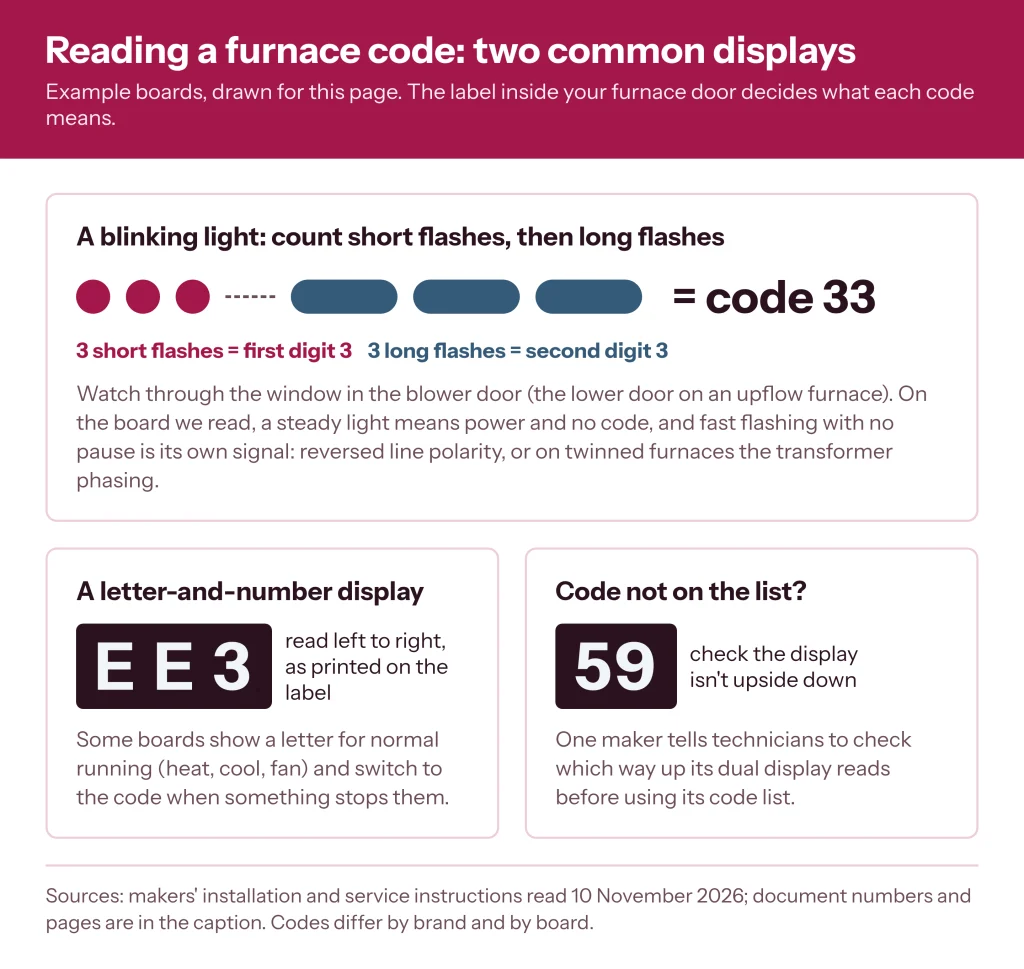
Write the code down before you switch anything off, along with the brand and model from the rating plate. Some boards also keep a short history of past faults (the Goodman and Lennox boards both do), but getting at it means pressing buttons on the board or, on the Carrier board, briefly disconnecting a limit wire behind the upper door. That’s the technician’s job. The code showing through the window is enough for you.
A worked example: the lookup’s starting choice
General information, not professional advice. Your system’s maker, your manual and a qualified technician decide what’s safe for your equipment, and local codes decide what needs a permit or a licensed installer.
The lookup opens on Carrier’s 59SC5 board with the amber light on steady. Carrier’s guide reads a steady light as a control that has power and no code, and its next question is whether the thermostat is calling (59SC5A-11SI, Fig. 70). So the lookup shows: no fault showing; normal status; your check is the thermostat on heat and above room temperature, with the furnace switch and breaker on, from the list in Carrier’s owner’s manual for its 80% furnaces (80GSFRN-B-03OM, page 7); the document; and the reminder that the label inside your furnace door decides. Pick Rheem and 22 instead and it shows an open main limit, with the filter and grilles as your check, while Carrier’s 22 is flame with the gas valve off and goes straight to a technician: the same number, two different problems.
The same faults, brand by brand
Different numbers, the same handful of checks. This table lines up the boards we read so you can see which family your code belongs to. A dash means that board’s list, as we read it, has no code for that fault.
| What stopped it | Carrier (59SC5) | Goodman (GR9S80) | Lennox (ML180) | Rheem (96V) |
|---|---|---|---|---|
| No flame proved; lockout after retries | 34, then 14 | E E 0 | E270 | 11, then 10 |
| Weak flame signal | within 34 | E E 6 | E240 | 12 |
| Flame lost after lighting | within 34 | within E E 0 | E273 | 13 |
| Pressure switch didn’t close or opened | 31 | E E 2 | E223, E227 | 45, 46, 57 |
| Pressure switch stuck closed | 23 | E E 1 | E224 | 44, 55 |
| Limit open (overheating) | 33, then 13 | E E 3 | E250, E274 | 22 |
| Flame rollout switch open | 33, then 13 | E 1 1 | E200 | 33 |
| Flame with the gas valve meant to be closed | 22 | E E 4 | E241, E275 | 14 |
| Low-voltage (24 V) fuse open | 24 | E E 5 | – | 30 |
| Ignitor fault | – | E E L, E E n | E290 | – |
| Refrigerant leak sensor (A2L coil) | – | E A L | E150 | – |
| Polarity or ground | rapid flash (polarity) | E E A | E111, E112 | 26 |
Every code we read, by brand
Open your brand for the full list. Meanings are our paraphrase of each maker’s table, not a copy; follow the link in each caption for the maker’s own words. “Who acts” is our reading of each maker’s document: “owner check” means the maker’s causes or actions for that code include something on the owner’s list in the next section (the filter, the gas valve, or one reset the maker prints); “urgent” marks flame sensed with the gas valve meant to be closed; everything else is the technician’s.
Carrier (59SC5A board, amber light): all 14 codes
| Code | What the maker’s document says (paraphrased) | Who acts |
|---|---|---|
| LED on steady, no flashing | Control powered, no code; Carrier's guide next checks the thermostat signals | Normal |
| Rapid flashing with no pause | Line polarity wrong, or on twinned furnaces the 24 V transformer phasing | Technician |
| 11: 1 short, 1 long flash | No previous code stored; stored codes clear after 72 hours | Normal |
| 12: 1 short, 2 long | Blower on after power-up: normal, runs 90 seconds | Normal |
| 13: 1 short, 3 long | Limit circuit lockout (limit or rollout open over 3 minutes); auto-reset after 3 hours; see 33 | Owner check, then technician |
| 14: 1 short, 4 long | Ignition lockout: no flame proved in 4 tries; auto-reset after 3 hours; see 34 | Owner check, then technician |
| 21: 2 short, 1 long | Gas heating lockout: gas valve relay stuck closed, or gas valve wire miswired or shorted; turn power off and wait 5 minutes to retry | Owner check, then technician |
| 22: 2 short, 2 long | Flame proved while the gas valve is off; inducer runs until cleared; Carrier checks for a stuck-open or leaky gas valve | Technician now (urgent) |
| 23: 2 short, 3 long | Pressure switch did not open: blocked pressure tube or switch stuck closed | Technician |
| 24: 2 short, 4 long | 24 V fuse open: a short in the 24 V wiring, thermostat leads included; Carrier says use only a 3-amp fuse | Technician |
| 31: 3 short, 1 long | Low or high pressure switch did not close or reopened: vent sizing, blocked or loose tubing, plugged drain, water in the vent, wind, inducer | Technician |
| 33: 3 short, 3 long | Limit or rollout open; rollout needs a manual reset; causes include a dirty filter, restricted ducts, loose blower wheel, gas input | Owner check, then technician |
| 34: 3 short, 4 long | Ignition proving failure: no flame sensed; 3 more tries before code 14; first checks: gas valve off, manual shut-off, ground wire, flame sensor | Owner check, then technician |
| 45: 4 short, 5 long | Control circuitry lockout; auto-reset after 1 hour; Carrier: reset power to clear, replace the control if it repeats | Owner check, then technician |
Goodman and Amana (GR9S80-family display): all 22 codes
| Code | What the maker’s document says (paraphrased) | Who acts |
|---|---|---|
| E E E | Internal fault or IRQ loss on the control: replace the board | Technician |
| E E 0 | Lockout after 3 ignition retries: gas interruption, ignitor, flame sensor, flue blockage, inducer | Owner check, then technician |
| E E 1 | Pressure switch stuck closed at the start of a heat call | Technician |
| E E 2 | Pressure switch open: blocked, pinched or misconnected hose, flue blockage, weak inducer | Technician |
| E E 3 | Open high limit: blocked filters or ducts, blower speed or failed blower | Owner check, then technician |
| E E 4 | Flame detected when there should be none: short in the flame sense circuit, lingering flame, slow-closing gas valve | Technician now (urgent) |
| E E 5 | Open fuse: short in the low-voltage wiring | Technician |
| E E 6 | Low flame signal: coated sensor, sensor position, gas pressure or combustion air | Technician |
| E E L | Ignitor relay fault on the control | Technician |
| E E A | Reversed line polarity or grounding error | Technician |
| E E b | Internal gas valve error | Technician |
| E E C | External gas valve error | Technician |
| E 1 1 | Open rollout switch: gas pressure, burner alignment or burner restriction | Technician |
| E E n | Ignitor open: check ignitor wiring, replace a damaged ignitor | Technician |
| E E J | Inducer relay error: replace the control board | Technician |
| E E H | Twin error: wiring, or the control board | Technician |
| E b L | Low blower (circulator) current: hard lockout; loose wiring or a burnt motor | Technician |
| E b U | Blower current unexpected (too high during pre-purge): hard lockout | Technician |
| E A F | Lost communication with the R-32 sensor: furnace in leak-response mode, fan only | Technician |
| E A L | R-32 leak detected: gas heat off, fan at full airflow until 5 minutes after the sensor stops detecting it | Technician (refrigerant leak) |
| E A S | R-32 sensor fault: furnace in leak-response mode, fan only | Technician |
| E A r | A2L relay fault on the control: leak-response mode; Goodman's actions include cycling power | Technician |
Lennox (ML180UHVK E-codes): all 36 codes, plus the status letters
| Code | What the maker’s document says (paraphrased) | Who acts |
|---|---|---|
| E000 | No error in memory | Normal |
| E106 | Twin communication fault (power off on one furnace, or 24 V out of phase) | Technician |
| E110 | Line voltage low | Technician |
| E111 | Line voltage polarity reversed | Technician |
| E112 | Ground not detected: system shuts down | Technician |
| E113 | Line voltage high | Technician |
| E114 | Line frequency out of range | Technician |
| E115 | Low 24 V (range 18 to 30 V); control restarts if it recovers | Technician |
| E117 | Poor ground detected (warning only) | Technician |
| E125 | Control failed self-check; Lennox: cycle power on the control, replace it if the problem persists | Owner check, then technician |
| E150 | Refrigerant leak detected at the indoor coil; can't clear while the sensor still reports a leak | Technician (refrigerant leak) |
| E151 | Leak detector sensor 1 fault | Technician |
| E152 | Leak detector sensor 2 fault | Technician |
| E154 | Leak sensor 1 communication lost or wrong DIP switch setting; blower runs at least 5 minutes | Technician |
| E155 | Leak sensor 2 communication lost; blower runs at least 5 minutes | Technician |
| E160 | Leak sensor 1 is the wrong type: replace with a Lennox-approved part | Technician |
| E161 | Leak sensor 2 is the wrong type | Technician |
| E163 | Furnace control board failure | Technician |
| E164 | Low GWP (leak sensor) test mode; clears after 1 minute | Normal |
| E200 | Hard lockout: rollout circuit open or previously open | Technician |
| E204 | Gas valve miswired | Technician |
| E223 | Pressure switch failed open: vent and inducer checks | Technician |
| E224 | Pressure switch failed closed | Technician |
| E227 | Pressure switch open during ignition or run | Technician |
| E240 | Low flame current: Lennox's action is 'Clean or replace sensor' and check the ground | Technician |
| E241 | Flame sensed out of sequence, flame still present: Lennox's action starts 'Shut off gas' | Technician now (urgent) |
| E250 | Limit switch circuit open: firing rate, blockage, airflow; 1-hour soft lockout if not closed in 3 minutes | Owner check, then technician |
| E270 | Soft lockout: too many retries, no flame current (gas flow, ignitor, flame sensor) | Owner check, then technician |
| E271 | Soft lockout: too many retries, last one failed on the pressure switch | Technician |
| E272 | Soft lockout: too many recycles, last one on the pressure switch | Technician |
| E273 | Soft lockout: too many recycles after flame failure (flame sensor, ground) | Technician |
| E274 | Soft lockout (1 hour): limit opened repeatedly or stayed open over 3 minutes | Owner check, then technician |
| E275 | Soft lockout (1 hour): flame sensed out of sequence; Lennox: 'Shut off gas', check for a leaking gas valve | Technician now (urgent) |
| E290 | Ignitor circuit fault: measure and replace the ignitor if out of specification; 1-hour soft lockout | Technician |
| E292 | Indoor blower motor can't start (seized bearing, stuck wheel); 1-hour soft lockout | Technician |
| E390 | Low GWP relay stuck on the control | Technician |
| H, C, A, d or a blinking dot | Status letters: gas heat, cooling, fan only, dehumidifying; blinking dot = idle | Normal |
Rheem (96V and 96MDV dual display): all 26 fault codes, plus the normal codes
| Code | What the maker’s document says (paraphrased) | Who acts |
|---|---|---|
| 0 | Standby: no fault and no call from the thermostat | Normal |
| h, H, c, C, F | Normal: low or high gas heat, low or high cooling, continuous fan (hP, HP, dF, cd and Cd are heat pump, defrost and dehumidifying modes) | Normal |
| d1 | No model data (memory card missing): the furnace will not run | Technician |
| d4 | No valid model data on the memory card; furnace still runs | Technician |
| d6 | Horsepower conflict between motor and memory card; furnace still runs | Technician |
| 10 | One-hour lockout, shown in turn with the code that caused it (11, 13, 14, 59, 61 or 93) | Technician |
| 11 | Failed ignition; after 4 in a row, one-hour lockout (10). Causes: flame sensor, gas valve off, ignitor, control, flame carryover | Owner check, then technician |
| 12 | Low flame sense (non-critical): clean or replace the flame sensor, check ground | Technician |
| 13 | Flame lost after it was established; retries follow | Technician |
| 14 | Flame present with the gas valve off: Rheem calls it 'extremely critical' | Technician now (urgent) |
| 22 | Main limit open: the heat exchanger area got too hot. Causes: no or low airflow, the limit control, wiring, a dead blower, gas input too high; Rheem's checks include the ductwork and filters. Open over 150 seconds, the control treats the blower as dead (61) and locks out for an hour (10) | Owner check, then technician |
| 23 | HALC circuit open: on these furnaces there is no HALC control, only a jumper wire on the board's connector, and the code usually means that jumper has lost contact | Technician |
| 26 | Line and neutral reversed, or poor ground: the furnace won't run in any mode | Technician |
| 30 | Open fuse: a 24 V short to common or ground | Technician |
| 33 | Rollout limit open: Rheem says it 'indicates a very serious problem that must be repaired' first | Technician |
| 44 | Low pressure switch closed with the inducer off (welded, wiring, or bypassed) | Technician |
| 45 | Low pressure switch open, inducer on high | Technician |
| 46 | Low pressure switch open, inducer on low | Technician |
| 55 | High pressure switch closed with the inducer off | Technician |
| 57 | High pressure switch open, inducer on high: vent blockage, length, inducer, hoses, wind | Technician |
| 58 | Water sensor circuit open | Technician |
| 59 | Water sensed in the collector box: blocked condensate drain or trap, or damaged sensor wiring | Technician |
| 60 | Blower fault, blower can still run (non-critical): the blower is at its speed, torque or temperature limit; Rheem’s fix is restricted ductwork or a filter that needs cleaning or replacing | Owner check, then technician |
| 61 | Blower fault, motor cannot run: furnace shuts down | Technician |
| 66 | Blower cutback: the blower is at its speed limit because airflow is restricted (ductwork, an obstruction, or a filter that needs cleaning or replacing); Rheem calls it an operating indicator, and the furnace keeps running | Owner check, then technician |
| 68 | The control can't communicate with the blower motor: the furnace won't run | Technician |
| 93 | Internal control fault, or voltage on the main gas valve when there should be none: Rheem calls it severe; the furnace shuts down | Technician |
| 99 | Notice: the stored fault codes have been cleared | Normal |
Bryant, Payne, Trane and other brands
Bryant and Payne belong to the Carrier family. Bryant’s own site signs off as “A Carrier Company”, and payne.com now says “Payne is now WeatherMaker by Carrier” and keeps Payne owner manuals there. But we have not read a Bryant or Payne code table on a maker site, and boards differ even within one maker, so the lookup doesn’t list them. Read the code with the short-and-long-flash method above, then match it to the label inside your furnace door.
Trane and American Standard. We found Trane’s installer’s guide for the S9V2 furnace on Trane Technologies’ literature site, which shows a seven-segment display and errors that alternate with the mode, but not a full fault list in readable text. So the lookup shows Trane as “not confirmed”. What Trane does print for owners is one lockout step: turn the power “on-off-on-off twice in 30 seconds” (Trane 32-5083-1C-EN, 2024, troubleshooting table). The same guide says a tripped flame rollout control or pressure switch “must be investigated by a qualified service technician”.
Other boards from the four listed makers. Two-stage, variable-speed and communicating furnaces often use different codes from the single-stage boards here, and older boards used flash counts that differ again. Even within one document they can differ: Goodman’s service manual for the GR9S80 family still says the diagnostic light on single-stage 80% models flashes six times for a rollout trip (RS6621301, page 20), while its display table shows E 1 1. If your furnace’s label doesn’t match the lookup, the label wins.
What you can check, where you stop, what the technician does
Every maker we read draws the same line. Carrier’s service section says owners can clean and replace filters and that “all other operations must be performed by trained service personnel” (59SC5A-11SI, page 75). Goodman says that if you service the unit “you assume responsibility for any injury or property damage” (RS6621301, page 1), and Lennox says installation and service must be done by “a licensed professional HVAC installer (or equivalent), service agency or the gas supplier” (508547-01, page 1). Trane warns that “do-it-yourself” repairs on an in-warranty unit may void the warranty.
You check
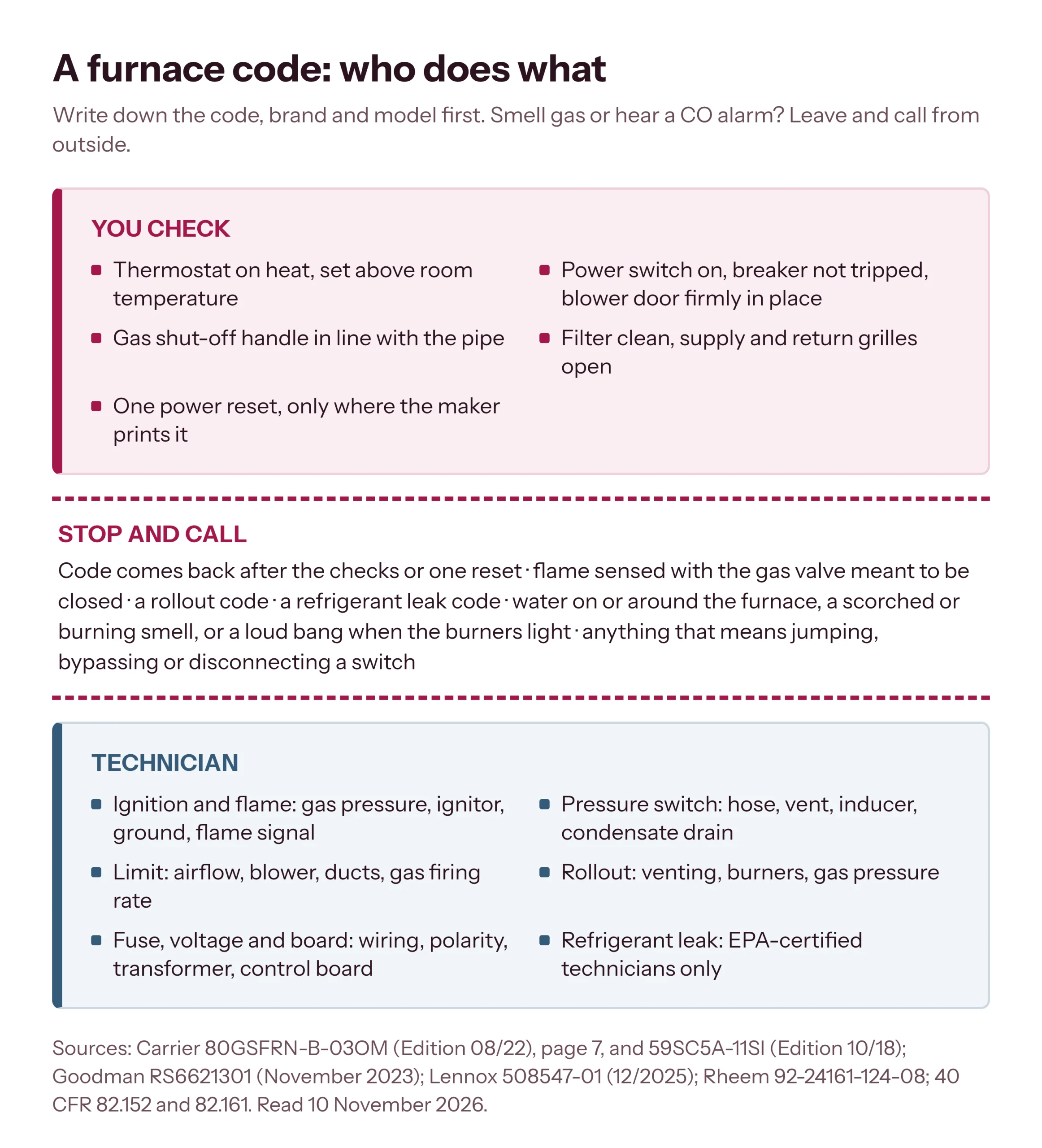
These are the checks Carrier’s owner’s manual lists “before you request a service call” (Carrier 80GSFRN-B-03OM, Edition 08/22, page 7), with the other makers’ versions where they differ:
- The thermostat. Set to heat, and above room temperature.
- Power. The furnace’s power switch is on, the breaker hasn’t tripped, and the blower door is firmly in place (the furnace won’t run with it off).
- Gas. The manual shut-off valve on the pipe to the furnace is open: the handle points the same way as the pipe, not across it. Carrier’s manual then has you turn the furnace’s power off and remove the access door before checking that the switch on the gas valve itself is ON. If either was off, Carrier says to make sure the gas wasn’t shut off for safety reasons before going further. The ignition codes point here first: Carrier 34 and Rheem 11 name a gas valve turned off, Goodman E E 0 a gas interruption, Lennox E270 the gas flow.
- Airflow. A dirty filter and closed or blocked supply and return grilles are the owner’s part of every overheating code (Carrier 33 and 13, Goodman E E 3, Lennox E250 and E274, Rheem 22), and Rheem names the filter for its blower codes 60 and 66. Goodman calls keeping filters clean “the owner’s responsibility” (RS6621301, page 11). Our guide to how often to change a furnace filter sets the makers’ intervals side by side.
- One power reset, only where the maker prints it. Carrier’s guide says to turn off power and wait 5 minutes to retry on code 21, and to reset power to clear code 45; Lennox’s action for E125 is to cycle power on the control; Trane’s owner guide gives “on-off-on-off twice in 30 seconds” for a lockout. Do it once. Then run a full heating cycle with the doors on and watch the code.
Stop
- You smell gas, or a CO alarm sounds: the boxes at the top of this page come first.
- The code comes back after the checks above or after one reset.
- The code says flame was sensed with the gas valve meant to be closed (Carrier 22, Goodman E E 4, Lennox E241 and E275, Rheem 14). Rheem calls it “an extremely critical fault”. Lennox’s action for E241 starts “Shut off gas”, and Carrier’s owner’s manual says that if the gas supply fails to shut off, shut off the gas valve to the furnace before the electrical supply (80GSFRN-B-03OM, page 3). Then call.
- A rollout code (Goodman E 1 1, Lennox E200, Rheem 33; Carrier’s 33 and 13 cover the limit or the rollout switch, so if a clean filter and open grilles don’t clear them, treat them the same way). Rollout means flame reached outside the burner area. The makers don’t agree on owner resets: Carrier’s owner’s manual for its 80% furnaces tells owners to push the button on the manual reset limit switches at the ends of the burner enclosure, which trip after a high-temperature condition from too little combustion air, and to turn the furnace off and call for service if one trips a second time (80GSFRN-B-03OM, page 7), while Trane says the cause “must be investigated by a qualified service technician” and Rheem says it “indicates a very serious problem that must be repaired before furnace operation can continue”. Because flame outside the burner area is also a fire and carbon monoxide sign, we’d have the cause investigated before any reset, even where your manual prints one, and never reset it twice.
- A refrigerant leak code (Goodman E A L, Lennox E150). See the next section.
- Water on or around the furnace, a scorched or burning smell, or a loud bang when the burners light. Carrier’s owner’s manual says to shut the furnace down and call if the burners light with a loud noise.
- Anything that would mean jumping, bypassing or disconnecting a switch. Goodman’s manual says “Do not bypass any safety limit connection”, and Rheem’s fix list for a pressure switch found closed with the inducer off includes reporting a bypassed switch as tampering.
Technician
What each family of codes leads a technician to, from the makers’ troubleshooting charts:
- Ignition and flame codes: gas pressure, the hot surface ignitor, flame carryover from burner to burner, the ground wire, and the flame sensor’s signal in microamps. Carrier gives a nominal 4.0 to 6.0 microamps for its board; Lennox calls anything above 1.5 normal and 0.5 to 1.4 low. Our flame sensor guide covers what Carrier’s service section does to clean one.
- Pressure switch codes: the switch’s hose and port, the vent and intake pipes for blockage, length and sags that hold water, the inducer motor, a plugged condensate drain on condensing furnaces, and the switch tested with a manometer. More in our pressure switch guide.
- Limit codes: airflow, blower speed and the blower itself, ducts, and the gas firing rate.
- Rollout codes: venting, burner alignment and restriction, gas pressure, and on Rheem’s list the heat exchanger and seals between the burner and blower compartments.
- Fuse, voltage, ground and board codes: wiring shorts (thermostat wires included), line voltage, polarity, the transformer, and the control board itself.
Our part guides give the makers’ own service steps where we found them, with each maker’s cautions. Goodman, Lennox and Trane tell owners not to service the unit, and Trane says do-it-yourself repairs on an in-warranty unit may void the warranty. If you’re not comfortable, or the code comes back, stop and call a technician. Burner orifices, gas pressure, gas piping and the heat exchanger stay a technician’s work. Some states and cities require a licensed gas fitter or a permit for gas work: Massachusetts, for one, requires a permit before gas fitting work and issues those permits only to licensed individuals, apart from gas company employees (248 CMR 3.05). Elsewhere, ask your building department. If the furnace still won’t heat and there’s no code, our checklist for a furnace that won’t turn on goes through it in order.
Newer furnaces: refrigerant leak codes
Newer air conditioners built for the 2025 refrigerant rules may use R-454B or R-32, which EPA lists in safety class A2L (EPA SNAP). EPA’s list marks them “Acceptable with Use Conditions” for this use. Furnaces paired with them read a leak sensor at the indoor coil, and the furnace board acts on it.
- Goodman “E A L” means the R-32 sensor found a leak. The furnace shuts down gas heat, switches on any alarm or ventilation output, and runs the blower at maximum airflow; once the sensor stops detecting refrigerant, the fan runs 5 more minutes before the furnace goes back to normal (RS6621301, page 9).
- Lennox E150 means a refrigerant leak was detected at or in the indoor coil. The code can’t be cleared while the sensor still reports a leak. Lennox’s own test sequence shows the blower powering up and the burners and outdoor compressor shutting down (508547-01, pages 36 and 48).
- Sensor faults (Goodman E A F, E A S, E A r; Lennox E151 to E161, E390) mean the sensor, its wiring or the relay that acts on it has a problem, not necessarily a leak. On Goodman’s board they also put the furnace in fan-only leak mode.
A fan that won’t stop and a cold house can be the furnace doing its job here. Let it run, and don’t unplug or disable the sensor: Lennox’s manual says “Disabling the refrigerant detection functionality on A2L system is prohibited by safety codes”. Finding and fixing the leak means opening the refrigerant circuit, which federal law reserves for EPA-certified technicians, with no homeowner exemption (40 CFR 82.152 and 82.161). Our guide to R-454B and R-32 explains the new refrigerants.
What to write down before you call
- The code exactly as shown: flash counts, or every character on the display, and whether it alternates with another code (Rheem’s one-hour lockout “10” alternates with the code that caused it).
- The brand, model and serial number from the rating plate. Carrier’s owner’s manual says knowing the exact furnace may let the dealer offer suggestions over the phone or prepare for the visit.
- What happened: when it stopped, whether it tried to light, any noise or smell, a power cut, snow or ice on the vent pipes outside, a recent filter change.
- Whether you reset it, and what happened after.
- On a 2025 or newer AC: whether the code is a refrigerant sensor code, and which refrigerant is on the outdoor unit’s label.

Questions worth asking: which part failed and what the code pointed to; whether the part is under warranty (Lennox ties its warranty to the yearly check by a licensed technician, 508547-01, page 41); and on a refrigerant code, whether the leak is being found and repaired or the system is only being topped up. Facing a big repair on an older furnace? Our repair-or-replace check sets your own repair quote against your own replacement quote.
Why code lists online may not match your furnace
Most code pages that rank today are parts sellers, contractors and copy sites. They mix boards and rarely say which document a code came from. A few things you may read elsewhere, checked against the makers’ text:
- “Stored codes clear after 48 hours.” Not on the Carrier board we read: its guide says stored codes are erased after 72 hours, and its installation section says a power cut doesn’t erase them.
- One code list for “Carrier, Bryant and Payne”. Carrier’s own document covers one board family, and codes vary between boards. We found no Bryant or Payne code table on a maker site to confirm the lists match, so the label in your door is the check. Across brands the numbers clash outright: 33 is limit or rollout on the Carrier board and rollout on Rheem’s, and 22 is flame with the gas valve off on the Carrier board but an open main limit on Rheem’s.
- “A flame code means a dirty flame sensor.” Cleaning the sensor is one of the actions, but the makers’ lists also name the sensor’s position or wiring, the ground, gas pressure or the control board, and Carrier’s chart only gets to cleaning after checking the gas valve and the ground wire.
- “Just reset the rollout switch.” Makers disagree: the ones that print an owner reset allow one, and we’d have the cause investigated before any reset. See the stop list above.
What to do now: read the code through the window, write it down with the model number, look it up above, make the owner checks the maker prints, and if it comes back, call. If you smell gas or a CO alarm sounds, leave first and call from outside.
Sources checked on 10 November 2026: Carrier 59SC5A-11SI (Edition 10/18) and 80GSFRN-B-03OM (Edition 08/22) on Carrier’s literature host; Goodman RS6621301 (November 2023) on goodmanmfg.com; Lennox 508547-01 (12/2025) on lennox.com; Rheem 92-24161-124-08 (printed 05/16) on pts.rheem.com; bryant.com and payne.com; Trane 32-5083-1C-EN (2024) and 18-CE03D1-1F-EN (13 May 2020); PHMSA, CPSC, CDC, EPA, the eCFR and 248 CMR 3.05. We could not read a Trane fault list in text, or a Bryant or Payne code table on a maker site.
Formulas and sources
- The code picked in the chosen brand's list: Row lookup on the reader's choice, no outside figure
- Maker's meaning, paraphrased (row data): Makers' code tables, paraphrased; documents listed on this page, read 10 Nov 2026
- Who acts, as the maker's document assigns it: Lennox 508547-01 installation instructions, 12/2025, pp. 47-49
- Owner check printed for this code or in the owner's manual: Carrier owner's manual 80GSFRN-B-03OM, Edition 08/22, pp. 3-7
- Maker's document for the chosen brand: Goodman RS6621301 service and troubleshooting, code table p. 41
- Board check reminder: Rheem 92-24161-124-08 installation instructions, Tables 19-20
Sources
- Carrier 59SC5 Single-Stage Condensing Gas Furnace Installation, Start-up, Operating and Service Instructions, 59SC5A-11SI, Edition 10/18 (troubleshooting guide Fig. 70)
- Carrier Non-Condensing 80% AFUE Gas Furnace Owner's Manual, 80GSFRN-B-03OM, Edition 08/22
- Goodman/Daikin Service and Troubleshooting, 80% Single Stage Gas Furnaces (GR9S80 family), RS6621301 (November 2023)
- Lennox ML180UHVK Merit Series Gas Furnace Installation Instructions, 508547-01, 12/2025
- Rheem (-)96V and (-)(-)96MDV Gas Furnace Installation Instructions, 92-24161-124-08 (printed 05/16), Tables 19-20, pp. 111-120
- Trane Gas Heating Systems Owner's Information, 32-5083-1C-EN (2024)
- Trane S9V2-VS Installer's Guide, 18-CE03D1-1F-EN (13 May 2020)
- Bryant 800S gas furnace page ('A Carrier Company', read 10 Nov 2026)
- Payne is now WeatherMaker by Carrier (payne.com, read 10 Nov 2026)
- PHMSA: Recognizing and Responding to Natural Gas Emergencies (read 10 Nov 2026)
- CPSC Carbon Monoxide Questions and Answers (read 10 Nov 2026)
- CDC: Carbon Monoxide Poisoning Basics (reviewed 26 Oct 2026)
- EPA SNAP: Substitutes in Residential and Light Commercial Air Conditioning and Heat Pumps (updated 19 Mar 2026)
- 40 CFR 82.152, definitions (eCFR, current to 6 Nov 2026)
- 40 CFR 82.161, technician certification (eCFR, current to 6 Nov 2026)
- Massachusetts 248 CMR 3.00 (Mass. Register #1559, 24 Oct 2025), section 3.05