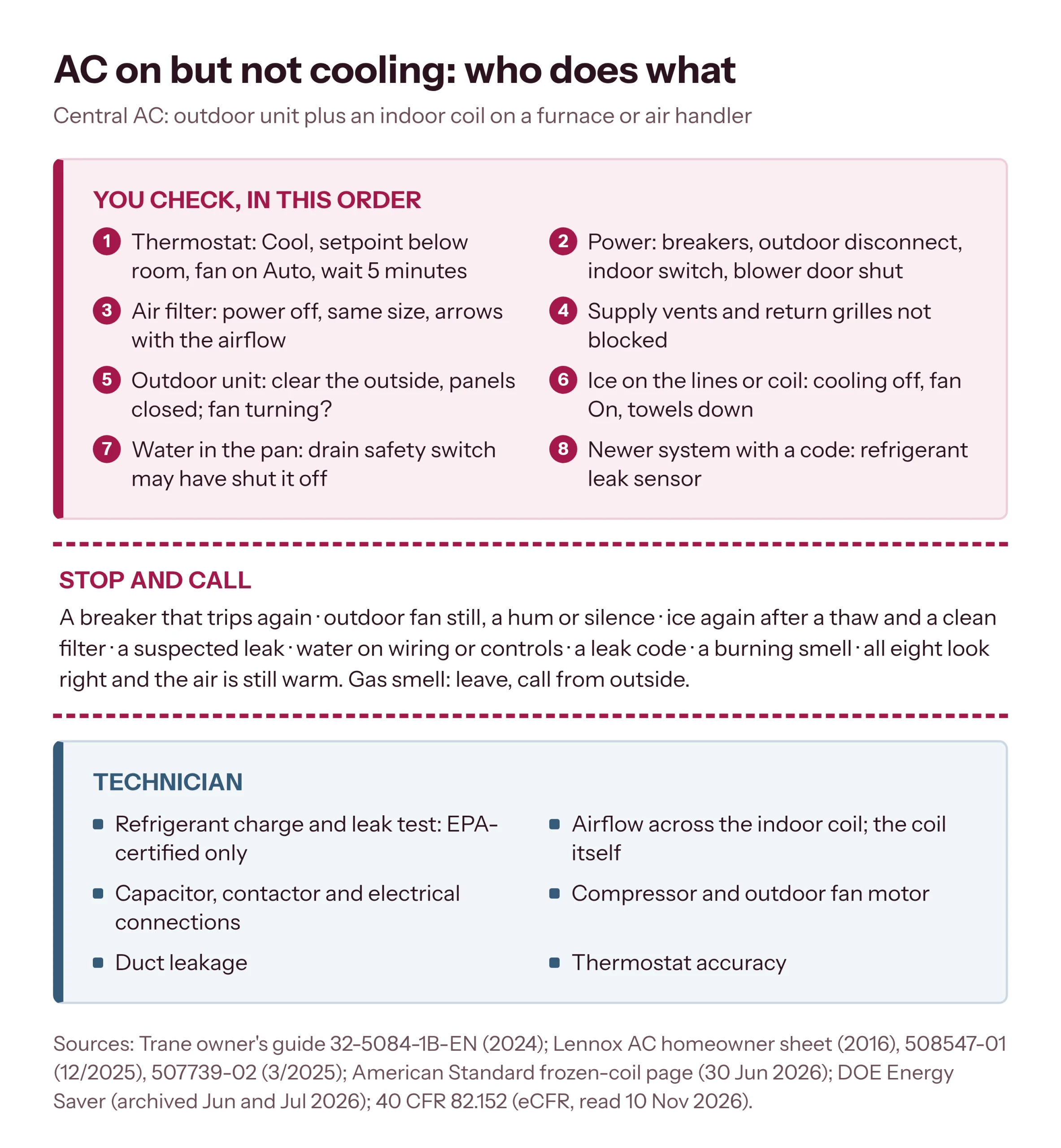
When a central air conditioner runs but the house stays warm, check in this order: the thermostat, the power (breakers, the outdoor disconnect, the switch and blower door at the furnace or air handler), the filter and vents, the outdoor unit, ice on the copper lines, and a drain safety switch that may have shut the system off. These are the checks the makers give owners (this page is part of our guide to AC problems). If they all look right and the vents still blow warm air, the rest is a technician’s job: the refrigerant charge and leaks, the capacitor, the contactor, the compressor and the airflow across the indoor coil. Federal law keeps the refrigerant side off limits to owners. Each step below names the maker or agency document it comes from.
General information, not professional advice. Your system’s maker, your manual and a qualified technician decide what’s safe for your equipment, and local codes decide what needs a permit or a licensed installer.
Before you start
Power off before you touch anything but the thermostat. Trane’s owner guide says to disconnect power to both the indoor and outdoor units before any maintenance, and warns that “there may be more than one electrical disconnect switch” (Trane, Air Handlers, Heat Pumps and Air Conditioners Owner’s Guide, Doc. 32-5084-1B-EN, 2024). Lennox’s homeowner sheet says the same: turn the power off at the disconnect switch before any service or maintenance (Lennox, AC System Information for Homeowner/User, 2016).
Don’t open the outdoor unit’s electrical panel. It carries 240 volts, and its capacitor can hold a charge after the power is off. Even the federal workplace safety rule (OSHA) requires stored energy in capacitors to be released before work, and says capacitors handled while doing that are treated as energized (29 CFR 1910.333(b)(2)(ii)(C)). No step on this page goes behind a panel.
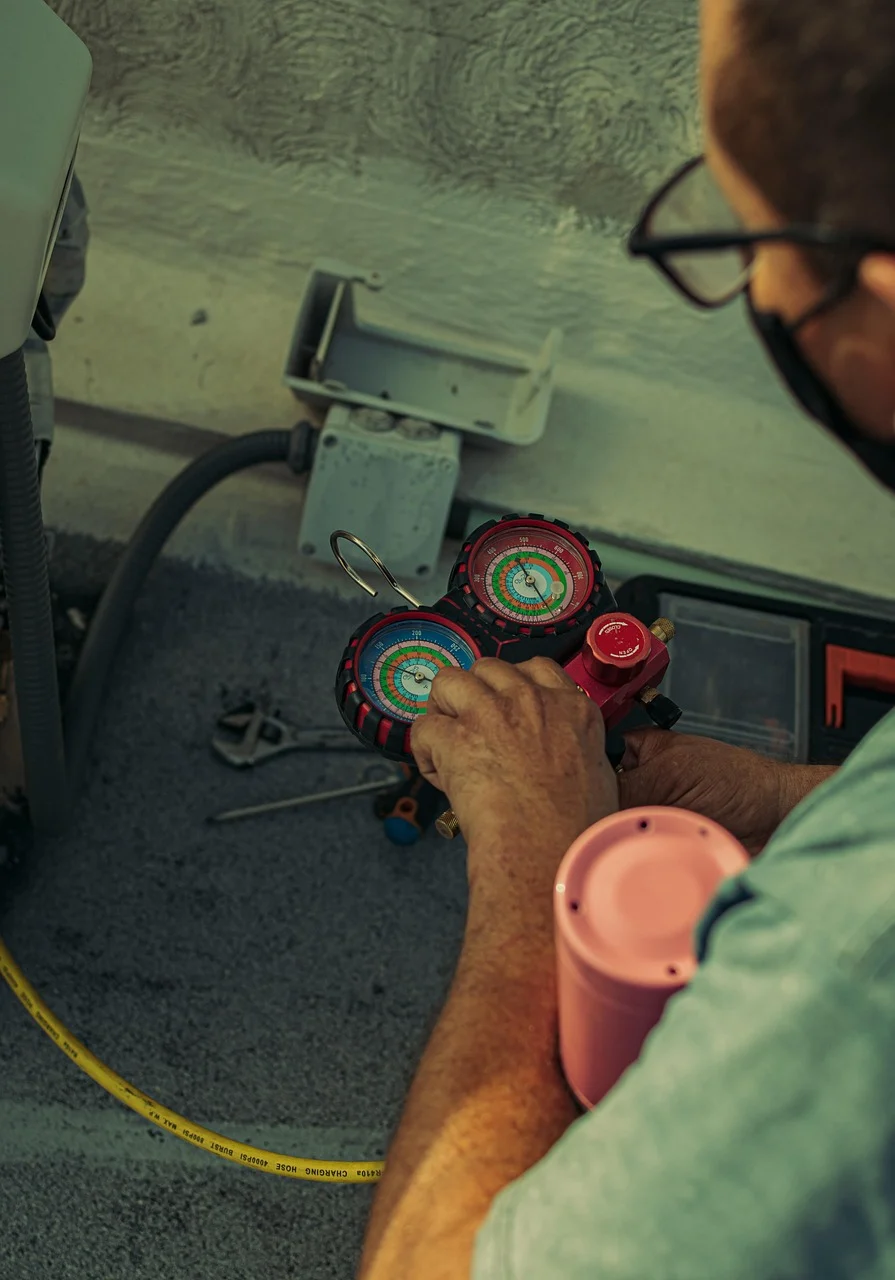
No refrigerant work. Attaching gauges, adding or removing refrigerant, or cutting a line is work only an EPA-certified technician may do (40 CFR 82.152, which defines the work, and 82.161, which requires the certification). There is no homeowner exception.
If you smell gas while you’re at the furnace: leave the house now. Don’t switch lights or appliances on or off, don’t use a phone inside, and don’t try to find the leak. From outside or a neighbour’s home, call 911 or your gas utility’s emergency line (PHMSA).
What kind of “not cooling” is it?
Stand at a supply vent and then at the outdoor unit for a minute. What you notice points to where to start.
| What you notice | Start with |
|---|---|
| Nothing runs at all, inside or out | Steps 1 and 2: thermostat and power |
| Air moves, but it’s room temperature | Step 1 (fan setting), then step 5: is the outdoor unit running? |
| Air is cool but weak, house never catches up | Steps 3 and 4: filter, vents, returns |
| Outdoor unit silent, or humming with the fan still | Step 5, then Stop |
| Ice or frost on the copper lines | Step 6: thaw it |
| Water in a pan under the indoor unit, system off | Step 7: drain safety switch |
| Newer system: blower runs hard, no cooling, a code on the furnace | Step 8: refrigerant leak sensor |
You check: eight steps in order
Lennox’s homeowner sheet gives the short version: before calling for service, check the thermostat settings, that every disconnect switch is on, that no fuse has blown or breaker tripped, that the access panels are in place and that the filter is clean. Trane’s owner guide has a similar table. The steps below follow that order and add what the makers and the Department of Energy (DOE) say.
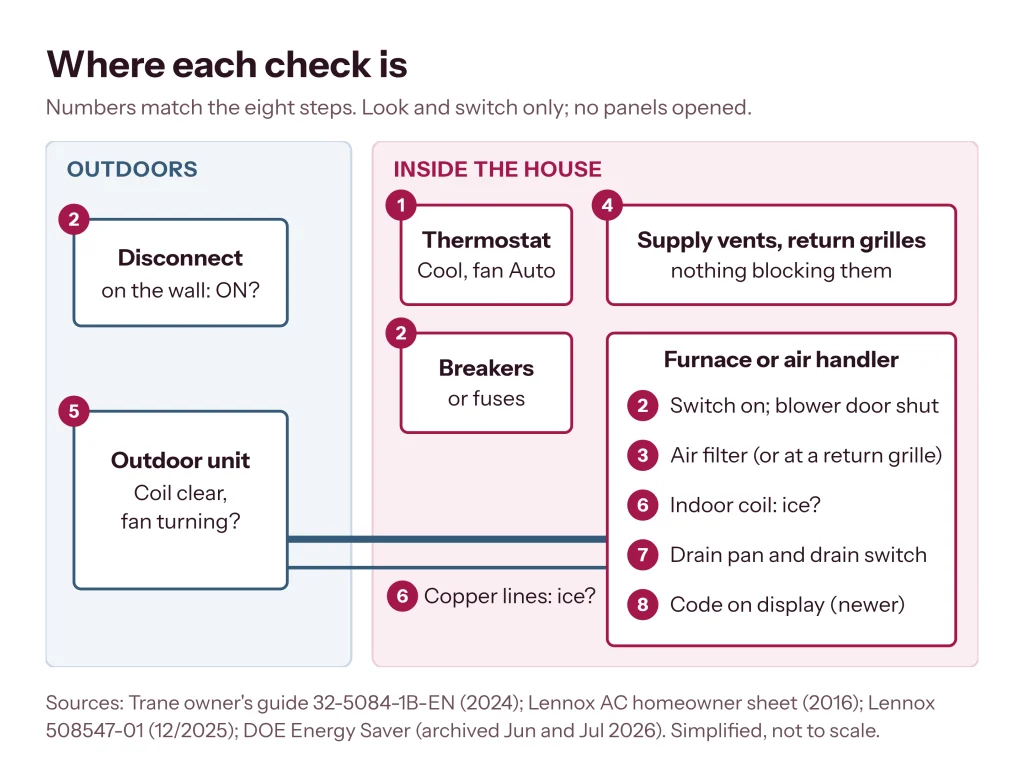
1. The thermostat: mode, setpoint, fan, and a five-minute wait
- Mode on Cool, setpoint below the room temperature. Trane’s owner guide lists an “improperly adjusted thermostat” under failure to operate. Trane’s troubleshooting page adds that a blank display can mean the thermostat is off or its batteries are dead (Trane, Air Conditioner Troubleshooting, read 10 November 2026). More help: our thermostat check in order.
- Fan on Auto, not On. With the fan set to On, the indoor blower runs even when there’s no call for cooling (Lennox describes this for its ML180 furnace, 508547-01, 12/2025), so between cycles the vents blow air that isn’t being cooled. Trane recommends Auto if the indoor air is above 60% relative humidity or simply feels humid.
- Give it five minutes. Some thermostats hold the compressor off for a few minutes after it stops, to protect it. Lennox’s M30 thermostat, for example, has a 5-minute delay between cooling cycles (Lennox M30 installation and setup guide, 507739-02, 3/2025, p. 3). Other makers’ delays and display messages differ: check your thermostat’s guide.
- Don’t set it very low to catch up. DOE says a colder setting “will not cool your home any faster” (DOE Energy Saver, Programmable Thermostats, Internet Archive copy of 1 July 2026; the live page returned 404 on 10 November 2026).
- Sun on the thermostat? DOE says it must be on an interior wall away from direct sunlight, drafts, doorways and windows (same page).
2. Power: breakers, the outdoor disconnect, the indoor switch, the blower door
A central AC usually has two halves on separate power: the outdoor unit (condenser and compressor) and the indoor unit (a furnace or air handler with the blower and the cooling coil).
- Breakers and fuses. Trane: if the system fails to operate, make sure the main switch is on, reset the circuit breaker or replace burned-out fuses. DOE’s page on common AC problems says to let the unit cool for five minutes before resetting (DOE Energy Saver, Common Air Conditioner Problems, Internet Archive copy of 8 June 2026).
- The outdoor disconnect. Usually a small box on the wall near the outdoor unit with a switch, a pull-out block or a breaker. Lennox’s pre-service check: “Verify that all electrical disconnect switches are ON.” Look at it; don’t open anything else in the box.
- The indoor switch. A furnace or air handler usually has a light-type switch on or near it. It’s easy to knock off when changing a filter.
- The blower door. Trane’s table says a blower door that is removed or ajar keeps the blower from running: close it securely. Lennox likewise says to check that the access panels are in place.
If a breaker trips again after one reset, leave it off. Trane’s troubleshooting page says a circuit that keeps tripping calls for an electrician.
3. The air filter
Trane’s owner guide names dirty filters first under “insufficient heating or cooling”, and DOE says a dirty filter cuts airflow and lets dirt build up on the indoor coil, which reduces its ability to absorb heat (DOE Energy Saver, Air Conditioner Maintenance, Internet Archive copy of 14 June 2026). Set the thermostat to off and switch off the power first, as Trane’s troubleshooting page says. Replace it with the same size and type, with the arrows pointing the way the air flows (Trane owner guide). The filter sits at the furnace or air handler, or behind a return grille in a wall or ceiling (Lennox). How often depends on the source: Trane says monthly and twice a month in heavy-use seasons, Lennox says check monthly, and DOE says every month or two in the cooling season if you’re unsure. Our filter interval page sets the sources side by side.
4. Supply vents and return grilles
Trane’s remedy for “air not circulating freely” is to check supply registers and return grilles for blockage. Look for furniture, rugs or curtains over them. DOE adds that closed-off rooms disrupt airflow through the home, and suggests keeping interior doors open (Common Air Conditioner Problems).
5. The outdoor unit: clear, and running?
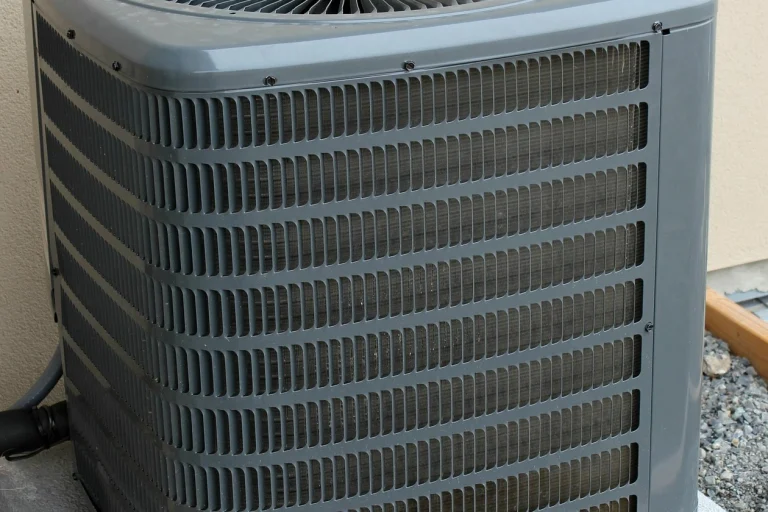
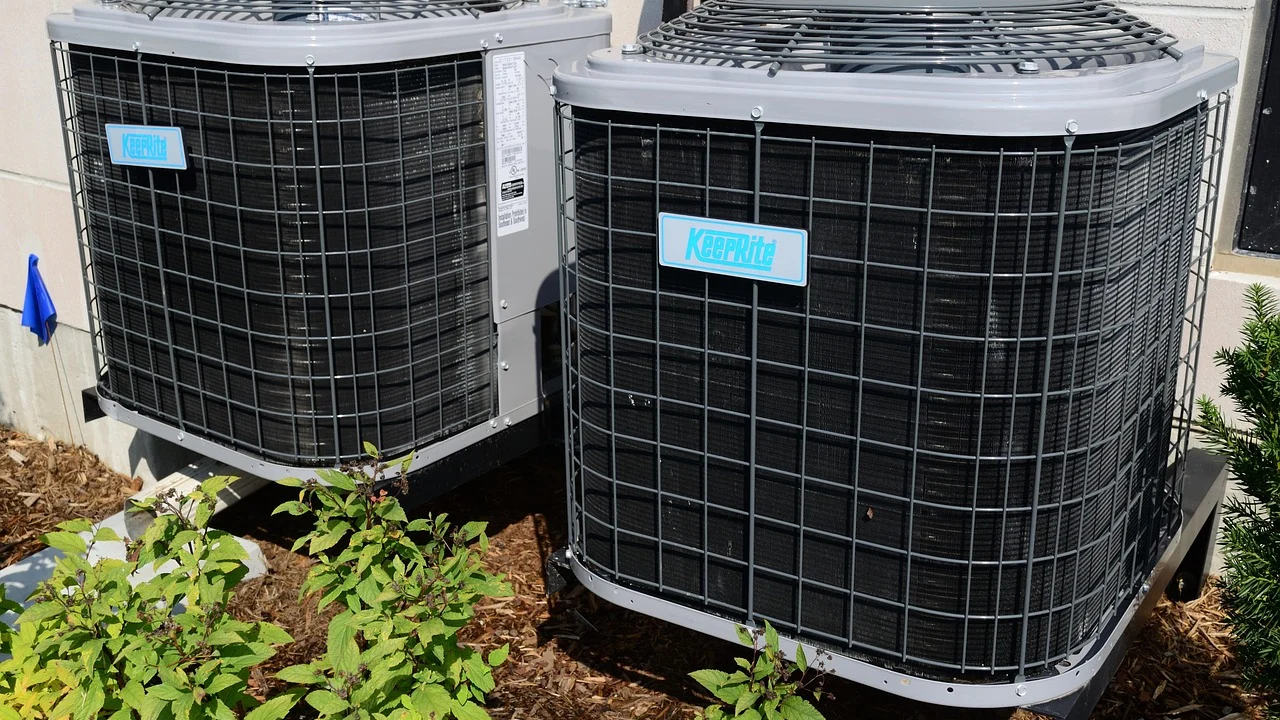
With the thermostat calling for cooling, go outside and look and listen, panels closed. The fan on top should be turning and you should hear the compressor running inside the cabinet.
- Blocked coil. Trane’s remedy for a blocked outdoor coil is to clear away leaves and debris; nothing should be stacked against the unit or draped over it, and no flowers or shrubs right next to it. Lennox says to check the outdoor unit monthly for grass clippings, leaves or paper pulled against the fins. DOE says to trim foliage back at least two feet (Air Conditioner Maintenance). Turn the power off at the disconnect first, as Lennox says, and work from the outside only: don’t reach into the unit or push anything through the fan grille.
- Fan not turning, a hum with no fan, or the unit silent while the indoor blower runs: stop here. These can point to the capacitor, the contactor, the fan motor or the compressor, all behind the panel; Trane’s troubleshooting page names a faulty capacitor as one possible cause and says a professional technician can diagnose it. Leave the unit off and see our outdoor unit not turning on page for what each sign points to.
- On a very hot afternoon, DOE says a tripped high-pressure limit switch may stop the compressor (Common Air Conditioner Problems). Finding out why is a technician’s job.
6. Ice on the copper lines or the indoor coil
Frost or ice on the larger, insulated copper line at the outdoor unit, or on the indoor coil where you can see it without opening a panel, means the coil has frozen. American Standard’s homeowner page (a Trane Technologies brand) gives these steps (American Standard, Frozen Evaporator Coil? Don’t Panic, 30 June 2026):
- Turn cooling off at the thermostat and set the fan to On to speed the thaw. Running the system with a frozen coil “can do major damage”, the page says.
- Get ready for water: a fully iced coil can release 1 to 2 gallons. Put towels, a tub or a bucket where it will drip.
- Check the filter and make sure supply registers and returns aren’t blocked.
- Don’t chip at the ice.
- Call for service; a technician needs the coil thawed to assess it.
The page lists the causes as a dirty filter, a dirty coil, blocked returns, a faulty thermostat, and low refrigerant from a leak. If it freezes again with a clean filter and open returns, the rest of that list is for a technician. More on ice on the coil or lines.
7. A drain safety switch that shut the system off
Cooling pulls water out of the air, and it drains from a pan under the indoor coil. DOE says a clogged drain can make the equipment turn off until the drain is cleared, or overflow and cause water damage (Air Conditioner Maintenance). That shut-off comes from a water-level switch (often called a float switch) in the pan or drain line. The model building code lists one as a way to protect the building from an overflow: the 2024 International Residential Code, Section M1411.9.1, allows a water-level detection device that shuts off the equipment if the primary drain is blocked, and Section M1411.9.1.1 requires one inside the primary pan on down-flow units and other coils with no room for a secondary drain (2024 IRC, Chapter 14). That is a model code; your building department decides what applies to your home.
Signs: the system stopped cooling and there is standing water in the pan under the indoor unit or in an extra pan under an attic unit. Lennox says to have your dealer show you the drain line and how to check it, and to check it, and any auxiliary drain, monthly. Trane says condensate drains should be checked and cleaned periodically. The steps for clearing it are on our clogged AC drain line page. Never tape, jump or bypass the switch: it is there to stop a flood. If water has reached wiring or the furnace controls, switch the power off at the breaker and stop. If any part of a gas furnace has been under water, don’t run it: Trane’s gas furnace owner guide warns that a flood-damaged unit is extremely dangerous and that a qualified service agency should inspect it and replace the gas controls and electrical parts that got wet (Trane, Gas Heating Systems Owner’s Information, Doc. 32-5083-1C-EN, 2024).
8. Newer systems: the refrigerant leak sensor
Many systems made from 2025 on use R-454B or R-32, A2L refrigerants (mildly flammable). For R-454B, EPA’s use conditions require a permanent “WARNING—Risk of Fire. Flammable Refrigerant Used” marking on the outside of the equipment (40 CFR 82 subpart G, appendix W). Many of them have a refrigerant sensor at the indoor coil that the furnace or air handler reads. When it detects a leak, the board takes over on purpose:
- Lennox (ML180UHVK, 508547-01, p. 35): the furnace control cuts power to the thermostat, which shuts off the outdoor compressor and any heat; “No heating or cooling demands will be met”. The blower runs on high to purge refrigerant from the cabinet and ducts, keeps running for the rest of a seven-minute cycle once levels fall, and then the system returns to normal. The display shows E150.
- Goodman/Daikin (GR9S80 family furnaces paired with an R-32 system, RS6621301, November 2023, p. 9): the display shows EAL, gas heat shuts down and the fan runs at maximum airflow until 5 minutes after the sensor stops detecting the leak. This document doesn’t describe what the outdoor unit does.
A blower that won’t stop, no cooling, and one of these codes point to a leak alarm or a sensor fault, not a broken fan control. Lennox says “Disabling the refrigerant detection functionality on A2L system is prohibited by safety codes” (508547-01, p. 1). Write down the code and call a technician. Other brands’ boards use other codes: check the label inside your furnace door, and our furnace error code lookup lists the codes we have read in each maker’s own document.
Stop: where the owner’s part ends
Trane’s owner guide says that apart from the simple maintenance it lists, owners “should not attempt to make any adjustments or repairs”, and that “do-it-yourself” repairs on an in-warranty unit may void the warranty. Lennox says installation and service must be done by a licensed professional HVAC installer or service agency (508547-01), and its homeowner sheet asks for an inspection by a licensed professional technician twice a year. Stop and call when:
- a breaker or fuse trips again after one reset;
- the outdoor fan doesn’t turn, the unit hums without starting, or it stays silent while the thermostat calls for cooling;
- the coil freezes again after a thaw and a clean filter;
- you suspect a refrigerant leak;
- water has reached wiring or controls, or the drain switch trips again soon after clearing;
- a newer system shows a refrigerant leak code;
- you smell burning from the unit or the wiring: switch it off at the breaker;
- you smell gas at the furnace (see the box above);
- all eight checks look right and the vents still blow warm air.
Technician: what they check, and why
DOE lists what a technician should do when a system fails to cool the home adequately (Air Conditioner Maintenance):
- Refrigerant charge and leaks. Check the charge, test for leaks, and capture any refrigerant removed so none is illegally released. DOE’s common-problems page adds that a low system was either undercharged at installation or leaks, and that the leak should be fixed and the repair tested before the system is charged. Our refrigerant leak page covers what the law asks of the technician.
- Airflow across the indoor coil, and the coil itself: DOE says it collects dirt over time even with a clean filter.
- Electrical parts and connections. DOE: inspect terminals, clean and tighten connections, check the control sequence. Behind the outdoor panel are the capacitor (it stores a charge to start and run the compressor and fan motors) and the contactor (a switch that the thermostat’s low-voltage signal closes to send line power to the outdoor unit). DOE’s common-problems page notes that frequent on-off cycling and corrosion of wires and terminals cause electric control failures.
- The compressor and outdoor fan motor. DOE’s common-problems page warns that dirty filters and coils can lead to early compressor or fan failure.
- Duct leakage and the thermostat’s accuracy, both on DOE’s list.
Why there’s no “top it up yourself” step
Under the Section 608 rules, anyone whose work “could be reasonably expected to violate the integrity of the refrigerant circuit” must be a certified technician; the rule’s examples are attaching or detaching hoses and gauges, adding or removing refrigerant, adding or removing components, and cutting a line (40 CFR 82.152); the certification requirement itself is in 40 CFR 82.161. EPA says “Only Section 608 certified technicians can purchase refrigerants intended for use with stationary refrigeration and air-conditioning equipment”; the small-can exception is for car air conditioning (EPA, Refrigerant Sales Restriction, updated 23 March 2026). Some websites suggest topping up a home system from a store-bought can. For a central AC, the federal rule doesn’t allow it.
Questions worth asking when a technician says the system is low: where is the leak, and will they repair it or only add refrigerant? Which refrigerant does the system use: R-22, R-410A, R-454B or R-32 (it’s on the outdoor unit’s rating plate)? Is the part under warranty? R-22 has not been made or imported in the US since 1 January 2020, though existing systems may keep using it (EPA-430-FR-20001). R-410A systems can still be repaired: the federal ban on making and selling products that use high-GWP refrigerants doesn’t apply to components such as condensing units, coils and compressors (40 CFR 84.56(b)). If the quote is large or the system is old, our repair or replace check lays out the points to weigh using your own quotes.
What to do next
- Now: Cool, fan on Auto, breakers and disconnects on, blower door shut, clean filter, outdoor unit clear. Wait five minutes and listen outside.
- If there’s ice: cooling off, fan On, towels down, and don’t run cooling again until it has thawed and the cause is found.
- Write down for the technician: the model and serial numbers from the rating plates outside and on the furnace or air handler (Lennox asks owners to have the model number ready), any code on the furnace display, what you checked, and when it started.
- Ask: is this a leak repair or just a top-up, which refrigerant does it use, and is the part under warranty.
- Can’t wait: a burning smell from the unit or wiring, a breaker that trips repeatedly, water on electrical parts, or a gas smell at the furnace.
Sources checked on 10 November 2026. Makers: Trane 32-5084-1B-EN (2024) and Trane’s troubleshooting page; Trane 32-5083-1C-EN (2024); Lennox’s AC homeowner sheet (2016), 508547-01 (12/2025) and 507739-02 (3/2025); Goodman/Daikin RS6621301 (November 2023); American Standard’s frozen-coil page (30 June 2026). DOE Energy Saver pages in Internet Archive copies (the live pages return 404); EPA’s sales-restriction page and R-22 fact sheet; 40 CFR 82.152, 82.161, part 82 subpart G appendix W and 84.56, and 29 CFR 1910.333 in the eCFR; the 2024 IRC, Chapter 14, in the ICC’s free viewer (model code). We could not find a current Carrier or Goodman central AC owner’s manual on the makers’ own websites.
Sources
- Trane, Air Handlers, Heat Pumps and Air Conditioners Owner's Guide, Doc. 32-5084-1B-EN (2024)
- Trane, Gas Heating Systems Owner's Information, Doc. 32-5083-1C-EN (2024)
- Trane, Air Conditioner Troubleshooting (read 10 Nov 2026)
- Lennox, AC System Information for Homeowner/User (2016)
- Lennox ML180UHVK Installation Instructions, 508547-01 (12/2025)
- Lennox M30 Thermostat Installation and Setup Guide, 507739-02 (3/2025)
- Goodman/Daikin Service and Troubleshooting, 80% Single Stage Gas Furnaces, RS6621301 (November 2023)
- American Standard, Frozen Evaporator Coil? Don't Panic (30 Jun 2026)
- DOE Energy Saver, Common Air Conditioner Problems (Internet Archive copy, 8 Jun 2026)
- DOE Energy Saver, Air Conditioner Maintenance (Internet Archive copy, 14 Jun 2026)
- DOE Energy Saver, Programmable Thermostats (Internet Archive copy, 1 Jul 2026)
- 40 CFR 82.152, definitions (Section 608 technician)
- 40 CFR 82.161, technician certification
- EPA, Refrigerant Sales Restriction (updated 23 Mar 2026)
- EPA, Residential Air Conditioning and the Phaseout of HCFC-22, EPA-430-FR-20001
- 40 CFR 84.56, exemptions for specified components
- 40 CFR part 82 subpart G, appendix W (R-454B use conditions)
- 29 CFR 1910.333, stored electric energy
- PHMSA, natural gas emergency response
- 2024 International Residential Code, Chapter 14, M1411.9.1 and M1411.9.1.1 (model code, ICC free viewer)